Photochromic Lenses in San Francisco: The Complete Guide to Adaptive Eyewear for Bay Area Living
Last Tuesday morning, Marcus Rivera walked into our Cow Hollow practice with a familiar complaint. A product designer at a tech startup near Union Square, he'd just spent $450 on progressive lenses—but forgot to ask about photochromic technology. "I'm constantly switching between my regular glasses and prescription sunglasses," he told me, frustrated. "Walking from my SOMA office to lunch in Yerba Buena Gardens means carrying two pairs everywhere. And half the time, I forget my sunglasses in the car or at my desk."
Marcus isn't alone. After 30 years fitting eyewear in San Francisco, I'd estimate that 60-70% of my clients could benefit from photochromic lenses—yet most don't even know they exist, or worse, they've heard outdated myths about how "transition lenses" look or perform.
The truth? Photochromic lens technology has transformed dramatically in recent years. Modern adaptive lenses aren't your parents' chunky, slow-to-clear '90s transitions. Today's Transitions Gen S, XTR Active, and premium photochromic options offer lightning-fast activation, eight fashion-forward colors, polarization, and performance engineered specifically for our unique San Francisco microclimates—fog-to-sun commutes, coastal glare, and everything in between.
Whether you're biking the Embarcadero, driving across the Golden Gate Bridge, or simply tired of juggling multiple pairs of glasses, this guide will help you understand if photochromic lenses are right for your Bay Area lifestyle.
What Are Photochromic Lenses? The Science Behind Adaptive Eyewear
Photochromic lenses(commonly called "transition lenses" after the leading brand name) are clear indoors and automatically darken outdoors in response to UV light. Think of them as prescription glasses and prescription sunglasses combined into a single, seamless pair.
How the Technology Works
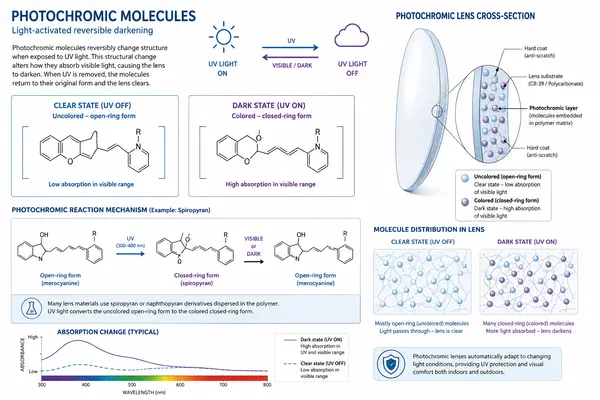
Modern photochromic lenses contain millions of specialized photochromic molecules embedded directly into the lens material—either through a process called imbibing (drawing molecules into the lens with heat) or Trans-Bonding™(applying them to the lens surface).
According to Transitions Optical, when UV light hits these molecules:
Activation:Molecules change their molecular structure within 30-60 seconds
Darkening:The altered structure absorbs visible light, causing the lens to darken (typically to 70-90% tint outdoors)
Clearing:When UV exposure stops (indoors), molecules return to their original state within 2-5 minutes
Key insight:The reaction is reversible and repeatable for the lifespan of the lens—typically matching your prescription's useful life (2-3 years for most wearers).
2026 Technology Advances
Today's photochromic lenses are light-years ahead of earlier generations:
Dual-activation chemistry:Some lenses now respond to both UV and visible light, allowing them to darken even inside cars (where windshields block UV)
Faster transition speeds:Gen S lenses darken in under 30 seconds and clear in under 2 minutes
Temperature performance:Modern formulations maintain darkening capability up to 40°C (104°F)—older lenses struggled in warm weather
Color variety:Eight vibrant colors beyond traditional grey and brown
Polarization integration:Xtractive Polarized combines adaptive tint with glare-blocking technology
Why San Francisco Residents Love (or Should Love) Photochromic Lenses
Our City's Unique Optical Challenges
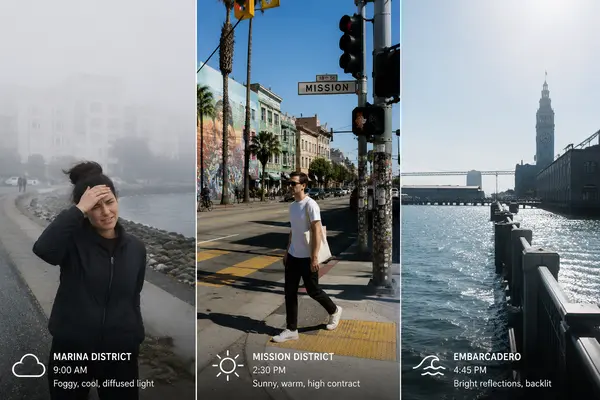
San Francisco's microclimate phenomenon creates lighting conditions unlike anywhere else:
Fog-to-sun transitions:Leave your Marina apartment in 55°F fog, arrive in Mission sunshine at 75°F—all within 15 minutes
Coastal glare:Reflected light off the Bay, Embarcadero waterfront, and Ocean Beach creates intense, eye-fatiguing brightness
Urban canyon effect:Walking between glass skyscrapers in FiDi or SOMA creates constant bright/shade cycling
Year-round UV exposure:Even "foggy" San Francisco averages 260+ sunny days; UV penetrates clouds
The problem:Carrying separate prescription sunglasses means:
Forgetting them40% of the time (average across my patient base)
Inconvenienceswitching mid-commute on BART, Muni, or ferries
Costof maintaining two pairs ($600-$1,200 total for quality lenses + designer frames)
Photochromic solution:One pair that automatically adapts, protecting your eyes 100% of the time without conscious effort.
The Comprehensive Pros & Cons: What the Research Shows
Advantages of Photochromic Lenses
1. Unmatched Convenience
Reality:You'll never forget your sunglasses again because your glasses are your sunglasses. For busy San Francisco professionals juggling work, gym, errands, and social commitments, this is transformative.
2. 100% UV Protection, Always
According to the American Academy of Ophthalmology, photochromic lenses provide continuous UV protection up to 400nm, blocking100% of UVA and UVB rays—even in their clear state indoors. This matters:
Cumulative UV damage contributes to cataracts (affecting 50% of people over 80)
Pterygium(surfer's eye) is common in Bay Area coastal residents
Macular degeneration risk increases with lifetime UV exposure
Expert insight:Many patients don't realize that unprotected indoor UV exposure from windows can accumulate. Photochromic lenses offer baseline protection even at your desk.
3. Reduced Eye Strain & Fatigue
Constantly adjusting to bright light (pupil constriction) and dim light (dilation) fatigues your eye muscles. Adaptive lenses smooth these transitions, reducing:
Headaches from bright light
Squinting (which contributes to crow's feet wrinkles)
Digital eye strain when moving between outdoor breaks and screen work
4. Cost-Effective Long-Term
Initial cost:Photochromic upgrade typically adds $100-$200 to lens pricing.
Alternative cost:Quality prescription sunglasses run $400-$800.
Savings:$200-$600, plus the convenience value of not managing two pairs.
5. Versatility Across Lifestyle Needs
Tech workers:Clear for Zoom calls, dark for lunchtime walks
Commuters:Adapt automatically on BART/Muni platforms and streets
Active lifestyles:Perfect for running, cycling, or hiking where swapping glasses is impractical
Fashion-conscious:Eight color options (including amethyst, emerald, sapphire) make a statement
Limitations to Understand
1. Variable Darkening Performance
Reality:Not all photochromic lenses darken equally. Factors include:
Temperature:Lenses darkenmore in cold weather,less in extreme heat (though 2026 technology has largely solved this)
Brand quality:Premium options (Transitions, Hoya Sensity, Tokai Lutina Photo 2) outperform budget alternatives
Age of lens:Photochromic molecules degrade over 3-4 years, reducing effectiveness
What to expect:
Standard photochromic: 70-80% darkening outdoors
Xtractive: 85-90% darkening (closer to dedicated sunglasses)
2. In-Car Performance (Standard Lenses)
The windshield problem:Most auto glass blocks 98-99% of UV rays, preventing standard photochromic lenses from activating.
Solution:Specialized options like Transitions XTR Active or Drivewear respond to visible light in addition to UV, achieving 50-70% tint behind windshields. (More on this in the driving section below.)
3. Fade-Back Time
Reality:Clearing takes 2-5 minutes indoors. For most situations (entering a store, office, restaurant), this is unnoticeable. But if you need instant clarity (e.g., walking into a dark movie theater), you'll experience a brief adjustment period.
Expert tip:If you attend frequent presentations, theater performances, or work in photography/videography where instant clear vision is critical, keep this in mind.
4. Slight Indoor Tint (Some Models)
Xtractive lenses maintain a subtle 5-10% tint indoors to keep molecules "primed" for faster activation. Most wearers don't notice, but if you prefer absolutely crystal-clear lenses indoors, standard Transitions or Sensity Fast are better choices.
Choosing the Right Photochromic Technology for Your Lifestyle
Not all adaptive lenses are created equal. Here's how to match technology to your San Francisco life:
Transitions Gen S (Latest Generation, 2026)
Best for:Fashion-forward individuals, fast-paced lifestyles, anyone wanting the newest technology
Key features:
Ultra-fast activation:Category 3 darkness in under 30 seconds
Eight vibrant colors:Amber, amethyst, emerald, graphite green, sapphire, copper, brown, grey
Quick fade-back:Clear in under 2 minutes
Gen S branding:Subtle, modern aesthetic
Ideal scenarios:
Hopping between indoor meetings and outdoor coffee breaks in FiDi
Marina District residents who walk/bike everywhere
Anyone who wants photochromic lenses that make a style statement
Cost:Typically $150-$250 upgrade
Transitions XTR Active (Extra Protection)
Best for:Light-sensitive individuals, drivers, coastal/outdoor enthusiasts
Key features:
Darkest tint outdoors:85-90% absorption (nearly true sunglass level)
Partial in-car activation:Darkens to 50-60% behind windshields (responds to visible light)
Slight indoor tint:8-10% for faster outdoor response
Extra blue-light filtering:Helps with digital eye strain
Ideal scenarios:
Daily commuters driving 101, 280, or across bridges
Sunset District/Ocean Beach residents battling intense coastal glare
Outdoor sales, real estate agents, or anyone in/out of cars frequently
Patients with light sensitivity or migraine triggers
Cost:Typically $180-$300 upgrade
Transitions XTR Active Polarized (Premium Option)
Best for:Serious outdoor enthusiasts, water sports, anyone who values glare elimination
Key features:
Combines photochromic + polarization:Adaptive tint PLUS horizontal glare blocking
Superior glare control:Eliminates reflections from Bay water, car hoods, glass buildings
Enhanced contrast:Sharper vision in bright conditions
Ideal scenarios:
Sailing, kayaking, paddleboarding on the Bay
Cycling the Embarcadero or Great Highway
Fishing, hiking, or any activity near water or reflective surfaces
Patients who've always wanted both technologies in one lens
Cost:Typically $250-$400 upgrade (premium positioning)
Trade-off:Slight reduction in indoor clarity (subtle polarization "haze" some people notice)
Hoya Sensity (Fast & Dark Options)
Best for:Budget-conscious quality seekers, those preferring non-Transitions brands
Key features:
Sensity Fast:Quickest fade-back (under 90 seconds clear)
Sensity Dark:Maximum outdoor darkness (up to 90%)
Six fashion colors:Including dynamic yellow and energizing orange for sports contrast
Spin-coating technology:Durable, long-lasting photochromic layer
Ideal scenarios:
Frequent indoor/outdoor transitions (retail, hospitality workers)
Athletes wanting enhanced contrast (yellow/orange tints)
Anyone who dislikes waiting for lenses to clear
Cost:Typically $120-$220 upgrade (often more affordable than Transitions)
Tokai Lutina Photo 2 (High-Temperature Performance)
Best for:Hot climate tolerance, high-prescription wearers
Key features:
Maintains darkening up to 40°C (104°F):Ideal for rare SF heat waves or travel
Blue-light filtering built-in:Lutina material protects against 400-420nm HEV light
Front + back UV protection:Blocks reflected UV from lens back surface
Cost:Typically $200-$280 upgrade
Photochromic Lenses & Driving in San Francisco: What You Need to Know
This is the #1 question I get:"Will my photochromic lenses work while I'm driving?"
The Short Answer
Standard photochromic lenses (Gen S, Sensity Fast, most budget options):Minimal to no darkening inside vehicles. Your windshield blocks the UV light they need to activate.
Specialized driving lenses (XTR Active, Drivewear):Yes—they darken to 50-70% behind windshields because they respond to visible light, not just UV.
Why This Matters for Bay Area Drivers
San Francisco driving presents unique challenges:
Bridge glare:Golden Gate, Bay Bridge, and Richmond-San Rafael crossings create intense water reflection
Tunnel-to-sunlight transitions:Broadway Tunnel, Waldo Tunnel—sudden brightness can be dangerous
Hill-driving sun exposure:Descending Twin Peaks or Russian Hill faces, you're driving directly into low-angle sun (especially winter months)
The risk:Squinting, eye strain, and delayed reaction times from unprotected glare.
My recommendation: If you drive daily in SF, invest in either XTR Active photochromics or a dedicated pair of polarized prescription sunglasses. Standard photochromics won't provide adequate in-car protection.
Safety note:According to research compiled by iDoctor Optical, standard photochromic lenses in their clear state don't impair driving safety—but they don't enhance it either. You're left unprotected from fatiguing glare.
Photochromic Lenses vs. Prescription Sunglasses: Making the Choice
When Photochromic Lenses Win
✅Convenience is your priority: You hate managing multiple pairs
✅Variable lighting throughout your day: Office ↔ outdoor meetings ↔ gym
✅Urban commuting: BART, Muni, walking, biking where swapping is impractical
✅Budget considerations: One premium pair vs. two separate pairs
✅Mild to moderate light sensitivity: Photochromics provide sufficient protection
When Dedicated Prescription Sunglasses Win
✅Maximum darkness needed:Beach days, sailing, snow sports (photochromics rarely exceed 90% tint; sunglasses reach 95%+)
✅Consistent outdoor time:If you're outside 80% of your day, dedicated sunglasses offer peak performance
✅Driving-focused:Polarized Rx sunglasses eliminate 99% of horizontal glare (no photochromic can match this)
✅Fashion versatility:Some people prefer distinct "looks" for glasses vs. sunglasses
✅Extreme light sensitivity:Chronic migraines, post-LASIK, certain eye conditions
The Hybrid Approach (My Personal Favorite)
Many of my San Francisco clients adopt a strategic two-pair system:
Primary pair:Photochromic progressive lenses (everyday wear)
Secondary pair:Polarized prescription sunglasses (kept in car for driving, beach, hiking)
Total investment:$800-$1,400 (depending on frame choices)
Benefit:95% convenience with 100% performance when needed
Photochromic Lenses + Progressive/Bifocal Prescriptions
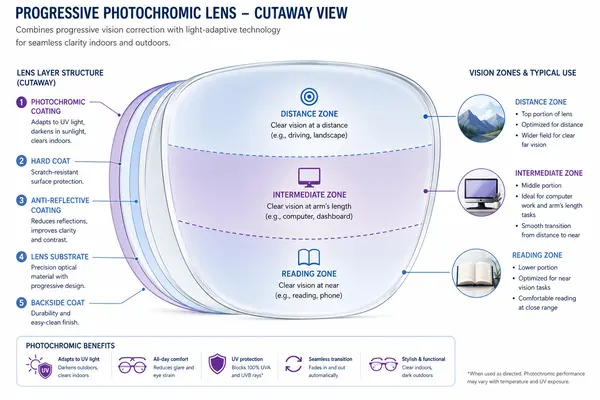
Great news:Photochromic technology works seamlessly with:
Single-vision lenses (distance or reading)
Bifocals
Progressive (no-line multifocal) lenses
High-index lenses (for strong prescriptions)
Anti-reflective, blue-light, and scratch-resistant coatings
Special Considerations for Progressives
If you wear progressives, photochromic lenses are especially valuable because:
You already can't easily swap glasses:Unlike single-vision wearers who might carry non-Rx sunglasses, progressive wearers need their specific prescription for all distances
Reading outdoors becomes comfortable:The adaptive tint reduces glare when reading menus at sidewalk cafes, checking your phone at the Ferry Building, or reading trail maps in Presidio parks
No compromise on lens design:Digital freeform progressives pair perfectly with Gen S or XTRActive coatings
Cost note:Photochromic progressive lenses typically run $500-$900 total (lens package). This is comparable to purchasing progressive lenses + separate progressive sunglasses ($800-$1,600).
Caring for Your Photochromic Lenses: Maximizing Lifespan
Daily Maintenance
✅Clean with microfiber cloth + lens cleaner: Avoid paper towels, shirt hems, or household cleaners (these can scratch or degrade the photochromic coating)
✅Rinse first: Remove dust/debris with lukewarm water before wiping
✅Store in protective case: Even minor scratches can interfere with uniform darkening
What to Avoid
❌Extreme heat:Don't leave glasses on a car dashboard in direct sun (above 140°F can damage photochromic molecules)
❌Harsh chemicals:Bleach, ammonia, acetone degrade coatings
❌Abrasive cloths:Use only microfiber designed for optics
Expected Lifespan
Photochromic effectiveness:2-4 years (molecules gradually lose reactivity)
Prescription relevance:2-3 years (most adults' prescriptions change within this window)
Physical lens condition:2-5 years (depending on care and usage)
Pro tip:Most patients naturally replace lenses when their prescription changes—meaning photochromic degradation rarely becomes an issue before you're due for new glasses anyway.
Common Myths About Photochromic Lenses—Debunked
Myth 1: "Transition lenses make you look old-fashioned or uncool."
Reality: This reputation came from 1990s technology—thick, slow-to-clear lenses in limited styles. Modern Gen S lenses come in eight fashion colors (including sapphire, emerald, amethyst) and are embraced by luxury eyewear brands like Oliver Peoples, Tom Ford, and Cartier. Many runway models and influencers wear photochromic lenses without most people even realizing they're adaptive.
Myth 2: "They don't work in cars."
Partial truth:Standardphotochromic lenses don't activate well in cars.Specializedlenses (XTRActive, Drivewear) are specifically engineered to darken behind windshields by responding to visible light. Know which you're buying!
Myth 3: "They take forever to clear indoors."
Outdated:1990s lenses took 5-10 minutes. Modern lenses (Gen S, Sensity Fast) clear in under 2 minutes, often closer to 90 seconds. Most people don't consciously notice the transition.
Myth 4: "They don't get dark enough to replace real sunglasses."
Depends on the lens:Standard photochromics darken to 75-80% (sufficient for most conditions). XTRActive reaches 85-90%—nearly identical to dedicated sunglasses. XTRActive Polarized combines adaptive tint with glare elimination, matching or exceeding standalone sunglasses performance for most activities.
Myth 5: "You can't add photochromic to high prescriptions or progressives."
False:Photochromic technology works with high-index lenses, progressives, bifocals, and even specialty lenses like Trivex or polycarbonate. No prescription is "too strong" for photochromics.
Myth 6: "They're just a gimmick to upsell you."
Reality:As an optometrist with zero commission on lens upgrades, I recommend photochromics based purely on patient lifestyle and eye health. The convenience and UV protection benefits are genuine—but they're not for everyone. This guide helps you decide based on your needs, not sales pressure.
Is Your San Francisco Lifestyle Right for Photochromic Lenses? A Decision Framework

You're an Ideal Candidate If:
✅ You commute via walking, biking, or public transit (frequent indoor ↔ outdoor transitions)
✅ You work in tech, creative, or professional fields with hybrid schedules
✅ You've forgotten sunglasses at home/car/office multiple times
✅ You hate carrying multiple pairs of glasses
✅ You spend time in SF's varied microclimates (Marina fog → Mission sun)
✅ You value convenience and simplicity in your daily routine
✅ You're light-sensitive but don't need maximum darkness constantly
✅ You're updating your prescription and want an all-in-one solution
Consider Alternatives If:
🤔 You drive 70%+ of your day and need consistent in-car darkness (get XTRActive or dedicated Rx sunglasses)
🤔 You need instant clarity when entering dark environments (theater professionals, photographers)
🤔 You spend 80%+ of time outdoors in bright sun (dedicated sunglasses may perform better)
🤔 You have extreme light sensitivity from medical conditions (consult with Dr. Blas for specialized tinting)
🤔 You prefer distinct fashion "looks" for glasses vs. sunglasses
🤔 Budget is tight and you can manage two pairs (though photochromics often cost less than buying both!)
Photochromic Lens FAQs: Your Questions Answered
Q1: How long do photochromic lenses take to activate and clear?
A:Modern lenses (Gen S, XTRActive) darken in 30-60 seconds outdoors and clear in 2-3 minutes indoors. Sensity Fast clears in under 90 seconds. Older technologies (pre-2020) took 3-5 minutes to clear, which is why some people have outdated negative impressions.
Q2: Will photochromic lenses work in San Francisco's fog?
A:Yes! Even though fog blocks visible light, it doesn't block UV rays—and UV is what activates standard photochromic lenses. You'll notice your lenses darken moderately in fog (30-50%) because UV penetrates clouds and mist. This actually helps with the diffuse glare fog creates.
Q3: Can I get photochromic lenses in my existing frames?
A:Usually, yes—if your frames are in good condition and the shape/size work with your prescription. At Eyes in Disguise, we can assess your current frames and re-lens them with photochromic lenses, saving you the cost of new frames. This is a great option if you love your current designer frames (Cartier, Oliver Peoples, etc.).
Q4: Do photochromic lenses protect against blue light from screens?
A:Some do! Transitions XTRActive and Hoya Sensity variants include blue-light filtering that blocks 15-30% of high-energy visible (HEV) blue light (400-450nm range). This helps with digital eye strain but isn't a substitute for dedicated blue-light-blocking lenses if you're a heavy screen user (8+ hours/day). Many patients combine photochromic + AR coating with blue-light filtering for comprehensive protection.
Q5: Are photochromic lenses suitable for sports and outdoor activities?
A:Absolutely—with considerations:
Cycling, running, hiking:Excellent. XTRActive Polarized is ideal for cutting glare on trails and roads.
Water sports:XTractive Polarized is a game-changer for sailing, kayaking, paddleboarding (eliminates water glare).
Snow sports:Decent, but dedicated sport-specific lenses with contrast-enhancing tints (yellow, orange, rose) may perform better in flat light. Photochromics work best in variable conditions.
Tennis, golf:Great—lenses adapt as clouds roll in/out, and you don't need to swap glasses mid-game.
Pro tip:For serious athletes, consider sport-specific frames with photochromic lenses (wraparound styles for maximum coverage and stability).
Q6: Will insurance cover photochromic lenses?
A:Most vision insurance plans (VSP, EyeMed, Davis Vision) provide a standard lens allowance ($100-$150 typically) that can be applied toward photochromic upgrades. You'll pay the difference out-of-pocket. Some plans offer specific "progressive" or "premium lens" add-ons that cover part of the photochromic cost. At Eyes in Disguise, we'll verify your benefits and maximize coverage—often reducing your out-of-pocket cost to $50-$150 for photochromic upgrades.
Q7: Can I combine photochromic lenses with anti-glare (AR) coating?
A:Yes—and you absolutely should! Anti-reflective coating eliminates reflections from thebacksurface of your lenses (headlights, screens, overhead lights), while photochromic technology controls light comingthroughthe lenses. They're complementary technologies. Most premium photochromic packages include AR coating as standard.
Q8: What's the difference between Transitions Gen S and XTRActive?
A:
Gen S:Fastest activation/clearing, eight fashion colors, standard outdoor darkness (75-80%), minimal indoor tint. Best foreveryday convenience and style.
XTRActive:Darkest outdoor tint (85-90%), partial in-car activation (50-60%), slight indoor tint (8-10%), extra blue-light filtering. Best forlight sensitivity, driving, and maximum protection.
Think of Gen S as "balanced performance + fashion" and XTRActive as "maximum protection + driving functionality."
The Eyes in Disguise Advantage: Why Choose Us for Your Photochromic Lenses
30+ Years of San Francisco Optometry Expertise
Dr. Michelle Blas has fitted tens of thousands of photochromic lenses for Bay Area residents since the technology's early days—meaning she understands both the evolution of the tech and the unique demands of SF living.
What sets us apart:
✅Honest guidance:No commission-driven upselling. If photochromic lenses aren't right for your lifestyle, we'll tell you—and recommend better alternatives (maybe polarized Rx sunglasses, maybe simple clear lenses).
✅Curated luxury eyewear:Our frame collection (Cartier, Oliver Peoples, Tom Ford, Dita, Garrett Leight, Persol) pairs beautifully with photochromic technology. Style doesn't compromise performance.
✅Advanced diagnostics:Digital measurements ensure your photochromic lenses align perfectly with your optical centers—critical for progressives and high prescriptions.
✅Lifetime adjustments:Your photochromic glasses will evolve with your face and lifestyle. We provide complimentary adjustments for life (frame fit, temple adjustments, nose pad replacements).
✅Try-before-you-commit demos:We can show you lens samples demonstrating activation speed and tint levels in real-time—step outside our Union Street boutique and see the technology in action.
✅San Francisco-specific recommendations:We understand the Marina fog, FiDi glass canyons, and Golden Gate Bridge glare because we live and work here. Your lens prescription is customized for your neighborhood and commute.
How to Get Started: Your Path to Adaptive Eyewear
Step 1: Schedule a Comprehensive Eye Exam
Even if your prescription hasn't changed recently, an updated exam ensures:
Your photochromic lenses work with your most current vision needs
We assess eye health (dry eye, UV damage, digital strain) and recommend appropriate coatings/tints
You qualify for insurance benefits (many plans require exams within 12 months)
Book online: eyesindisguise.com or call (415) 474-5321
Step 2: Lifestyle Consultation
During your visit, we'll discuss:
Daily routine (commute, work environment, hobbies)
Current eyewear frustrations
Aesthetic preferences (fashion colors vs. neutral)
Budget considerations
Time investment:15-20 minutes (part of your exam appointment)
Step 3: Frame Selection
Choose from our curated collection of luxury and contemporary frames. Our team will guide you toward styles that:
Complement your face shape and coloring
Accommodate your prescription (high prescriptions need specific frame geometries)
Support your preferred lens size (larger lenses show more dramatic photochromic effect)
Step 4: Lens Customization
We'll configure your perfect lens package:
Photochromic type:Gen S, XTRActive, XTRActive Polarized, Sensity, etc.
Lens design:Single vision, progressive, or specialized (computer, readers)
Material:High-index (thin), polycarbonate (impact-resistant), Trivex (clarity)
Coatings:AR (anti-reflective), blue-light, scratch-resistant, hydrophobic (water-repellent)
Typical turnaround: 7-10 business days for standard prescriptions; 10-14 days for complex progressives or high-index materials.
Step 5: Fitting & Adjustment
When your glasses arrive:
Precision fitting ensuring optical centers align with your pupils
Temple adjustments for pressure-free comfort
Education on lens care and what to expect as lenses activate/clear
Step 6: Follow-Up (Optional but Recommended)
We encourage a 1-2 week check-in after you've worn your photochromic lenses in real-world SF conditions. Any minor adjustments (fit, comfort, cosmetic concerns) are handled complimentary.
Ready to Experience the Freedom of Adaptive Eyewear?
After three decades fitting eyewear in San Francisco, I can confidently say that photochromic lenses are one of the most underutilized technologies that dramatically improve quality of life for the right candidates.
If you're tired of managing multiple pairs, squinting in unexpected sunlight, or compromising your eye health because sunglasses are "too much hassle," photochromic lenses might be the simplest upgrade you never knew you needed.
Visit Eyes in Disguise at 2133 Union Street in Cow Hollow(between Fillmore and Webster), or call (415) 474-5321 to schedule your comprehensive eye exam and photochromic lens consultation.
Your eyes deserve seamless protection. Let's make it happen.
Book your appointment at eyesindisguise.com
About the Author
Dr. Michelle Blas, OD has been San Francisco's trusted optometrist for over 30 years, serving Cow Hollow, Pacific Heights, Marina District, Russian Hill, Nob Hill, and beyond. Board-certified in pediatric optometry and myopia control, Dr. Blas combines clinical precision with a passion for helping patients discover eyewear solutions that enhance both vision and lifestyle. Her boutique practice emphasizes patient education, lifetime support, and access to the world's finest eyewear brands—all without the corporate pressure of commission-based sales.
FAQ Section
Q1: Do photochromic lenses work in San Francisco's foggy weather?
A: Yes! Fog doesn't block UV rays—the trigger for photochromic activation. Your lenses will darken moderately (30-50%) in fog, helping reduce diffuse glare. San Francisco's fog actually makes photochromic lensesmoreuseful because you experience rapid fog-to-sun transitions throughout the day.
Q2: How quickly do modern photochromic lenses darken and clear?
A: Today's technology (Transitions Gen S, Hoya Sensity Fast) darkens in 30-60 seconds outdoors and clears in 2-3 minutes indoors. This is dramatically faster than older lenses (pre-2020) that took 5-10 minutes to clear, which gave photochromics an outdated reputation for sluggishness.
Q3: Will photochromic lenses darken inside my car?
A: Standard photochromic lenses (Gen S, Sensity Fast) provide minimal darkening (5-10%) inside cars because windshields block UV rays. However, specialized lenses like Transitions XTRActive or Drivewear respond to visible light and darken to 50-70% behind windshields, making them ideal for drivers.
Q4: Are photochromic lenses suitable for strong prescriptions or progressive lenses?
A: Absolutely! Photochromic technology works seamlessly with high-index lenses (for strong prescriptions), bifocals, progressives, and even specialty materials like polycarbonate. There's no prescription limitation. In fact, progressive lens wearers benefit most because they already need their specific prescription for all distances—eliminating the hassle of separate progressive sunglasses.
Q5: How much do photochromic lenses cost at Eyes in Disguise?
A: Photochromic upgrades typically add $150-$300 to your lens package, depending on the technology chosen (Gen S, XTRActive, XTRActive Polarized). For perspective, this is $200-$600 less than purchasing separate prescription sunglasses—plus you gain the convenience of one pair for all conditions. We accept all major vision insurance plans to help offset costs.
Q6: Do photochromic lenses provide 100% UV protection?
A: Yes! All photochromic lenses block 100% of UVA and UVB rays up to 400nm—even when they're completely clear indoors. This continuous protection helps prevent cumulative UV damage that contributes to cataracts, pterygium (surfer's eye), and macular degeneration. It's one of the key health benefits beyond convenience.
Q7: Can I get photochromic lenses in fashion colors?
A: Yes! Transitions Gen S offers eight vibrant colors: grey, brown, graphite green, amber, emerald, sapphire, amethyst, and copper. Hoya Sensity includes dynamic yellow and energizing orange for sports contrast. These fashion-forward options pair beautifully with designer frames from Oliver Peoples, Cartier, and Tom Ford—eliminating the outdated "transition lens" aesthetic.
Q8: How long do photochromic lenses last before they stop working?
A: Photochromic molecules gradually lose reactivity over 2-4 years, though most people replace lenses every 2-3 years when their prescription changes. In practice, photochromic degradation rarely becomes an issue before you're naturally due for updated lenses. With proper care (avoiding extreme heat, cleaning gently), they'll perform well for their intended lifespan.
