
Adjusting to New Glasses: Your Complete San Francisco Guide to Comfortable, Clear Vision
Everything You Need to Know About Breaking In New Eyeglasses, Troubleshooting Common Issues, and Ensuring Perfect Fit
When Marcus, a 45-year-old software architect from Russian Hill, picked up his first pair of progressive lenses, he was excited about finally having one pair of glasses for all distances. But two hours into wearing them at home, he felt dizzy walking down his stairs and had developed a pounding headache. "I thought maybe progressives just weren't for me," he told Dr. Blas when he came back the next day. "I was ready to return them."
The reality? Marcus's experience was completely normal—and temporary. His frames needed a minor adjustment (they were sitting too low on his nose), and his brain needed a few days to adapt to the new way of seeing through progressive zones. A week later, he couldn't imagine going back to separate reading glasses.
If you've recently gotten new glasses—whether it's your first pair, a significant prescription change, or a new lens type like progressives or bifocals—understanding what to expect during the adjustment period can mean the difference between frustration and confidence. This guide covers everything San Francisco residents need to know about breaking in new eyewear comfortably and successfully.
Why Do New Glasses Feel Different? The Science of Visual Adaptation

Your brain and eyes work as an integrated system. When you change your glasses prescription or lens design, you're essentially asking your visual system to recalibrate—and that takes time.
What Happens When You Get New Glasses
Optical Changes:
Even small prescription changes alter how light enters your eyes and focuses on your retina. Your brain must relearn spatial relationships, distances, and visual processing.
Peripheral Distortion:
New lenses—especially progressive lenses or strong prescriptions—may create peripheral blur or distortion that wasn't present in your old glasses. Your brain learns to ignore these areas and focus through the correct lens zones.
Frame Position:
If your new frames sit at a different angle, distance from your eyes (vertex distance), or height on your nose compared to old frames, the optical center shifts. This changes how you look through the lenses.
Muscle Memory:
Your eye muscles have developed patterns based on your old prescription. New glasses require different focusing efforts, particularly if your prescription has changed significantly.
Normal Adjustment Symptoms: What to Expect

Most people experience at least some of these symptoms during the first few days with new glasses. Understanding what's normal helps you distinguish between adjustment issues and problems requiring professional attention.
Common First-Week Symptoms
Mild Dizziness or Disorientation:
Especially with progressive lenses or significant prescription changes. The floor may appear closer or farther than usual, and stairs may feel challenging. This typically resolves within 3-5 days.
Mild Headaches:
Tension headaches from your eye muscles adapting to new focusing demands. Usually most noticeable after several hours of wear and lessens each day.
Peripheral Blur or "Fishbowl" Effect:
Objects in your peripheral vision may appear slightly curved or blurry, especially with strong prescriptions or progressive lenses. Your brain learns to compensate within a week.
Eye Strain or Fatigue:
Eyes feel tired after reading, computer work, or driving—particularly in the first 2-3 days. This improves as your visual system adapts.
Depth Perception Changes:
Reaching for objects, judging distances while driving, or navigating curbs may feel "off" initially. Most people adjust within 48-72 hours.
Increased Awareness of Frames:
You may notice the frame edges in your peripheral vision more than with old glasses. This awareness typically fades as your brain learns to filter it out.
Timeline for Adjustment

Single-vision glasses (nearsighted/farsighted only):2-3 days to 1 week
Single-vision with significant prescription change:3-7 days
Bifocals:4-7 days
Progressive lenses (first-time wearers):7-14 days
Progressive lenses (experienced wearers, new prescription):3-7 days
High-index or different lens material:2-5 days
8 Strategies to Speed Up Adjustment and Maximize Comfort
1. Commit to Full-Time Wear
Why it matters:
Switching between old and new glasses confuses your brain and prolongs adjustment. Each time you put on your old glasses, you reset the adaptation process.
What to do:
Wear your new glasses from the moment you wake up and keep them on all day. Put your old glasses away in a drawer—out of sight, out of mind. The only exception: if you experience severe symptoms (see "When to Seek Help" section).
San Francisco tip:
If you commute via BART or Muni, resist the urge to switch to old glasses for reading on transit. Your new progressives are designed for this—use them consistently.
2. Verify Proper Frame Fit
Why it matters:
Even the most accurate prescription won't work correctly if your frames are poorly positioned. Optical centers must align with your pupils, and the frame angle affects how you see through progressive corridors.
What to check:
Nose pads:Should rest comfortably without pinching or leaving marks
Temples:Should follow the contour of your head without pressing too hard behind ears
Frame height:Should sit level, not tilted up or down
Lens position:Eyes should look through the optical center (marked by a tiny dot or measured during fitting)
Pantoscopic tilt:Frames should angle slightly downward (typically 8-12 degrees) for optimal progressive lens function
What to do:
Return to your optician within 48 hours for complimentary adjustments if glasses feel uncomfortable, slide down your nose, or sit crooked. Most issues resolve with minor tweaks.
3. Practice Head Movements, Not Eye Movements (for Progressives)
Why it matters:
Progressive lenses have different zones for distance (top), intermediate (middle), and near (bottom). Looking through the wrong zone causes blur.
What to do:
For distance:Keep your head level and look through the upper portion
For computer/intermediate:Tilt your chin slightly up to look through the middle zone
For reading:Tilt your chin up more, looking through the bottom zone
When scanning:Turn your head rather than just moving your eyes side to side
Practice exercise:
Sit at your desk with a book at reading distance. Find the near zone by moving the book up and down until it's perfectly clear. Note the head position required. Practice this throughout the day.
4. Start with Stationary Activities
Why it matters:
Motion intensifies adjustment symptoms like dizziness and depth perception changes. Build confidence with stationary tasks first.
Recommended progression:
Days 1-2:Reading, desk work, watching TV (seated activities)
Days 3-4:Walking around your home, navigating stairs slowly with handrails
Days 5-7:Short walks outdoors, grocery shopping
Week 2+:Driving longer distances, hiking, sports
San Francisco considerations:
Our city's hills and uneven sidewalks make this progression especially important. Practice walking on flat Marina Green or Crissy Field paths before tackling Telegraph Hill or Russian Hill staircases.
5. Take Strategic Breaks (But Don't Remove Glasses)
Why it matters:
Visual breaks reduce eye strain without disrupting the adaptation process.
What to do:
Follow the20-20-20 rule: Every 20 minutes, look at something 20 feet away for 20 seconds. Keep your glasses on during breaks—just shift your focus to a distant object to relax your eye muscles.
Screen workers:
Set a timer or use apps like Stretchly or EyeCare to remind you. This is critical for San Francisco's heavy tech workforce spending 8+ hours daily on screens.
6. Optimize Lighting
Why it matters:
Poor lighting forces your eyes to work harder, amplifying adjustment symptoms and strain.
What to do:
Task lighting:Use desk lamps for reading and computer work
Reduce glare:Position monitors perpendicular to windows; use curtains or blinds
Adequate brightness:Avoid reading or detailed work in dim light
Consistent levels:Minimize drastic lighting changes (dim room to bright screen)
San Francisco microclimates:
Foggy mornings and bright afternoon sun create dramatic lighting shifts. Prepare by keeping blinds adjustable and having layered lighting options.
7. Keep Lenses Spotlessly Clean
Why it matters:
Smudges, dust, fingerprints, and salt spray (hello, Bay Area fog!) degrade optical clarity, making your eyes work harder and slowing adjustment.
Cleaning routine:
Morning:Rinse under lukewarm water, apply lens cleaner, dry with microfiber cloth
Throughout the day:Keep a microfiber cloth in your bag for quick wipes
Evening:Full cleaning before bed
What NOT to do:
Avoid using your shirt, paper towels, tissues, or household cleaners—these scratch lenses and damage coatings.
8. Maintain Realistic Expectations
Why it matters:
Understanding that discomfort is temporary helps you push through the adjustment period instead of giving up prematurely.
Mindset shift:
Think of new glasses like breaking in new shoes. The first few days might be uncomfortable, but proper fit and consistent wear lead to long-term comfort and better vision.
Document progress:
Keep brief notes: "Day 1 – moderate headache by afternoon. Day 3 – only slight dizziness on stairs. Day 5 – feeling much better!" Seeing improvement motivates continued wear.
Special Considerations for San Francisco Residents
Commuting and Transit
BART/Muni:
Train motion combined with new glasses can initially increase dizziness. Start with short trips during off-peak hours. Focus on stationary objects (not passing scenery) to reduce motion-related symptoms.
Walking:
Our famously uneven sidewalks, cable car tracks, and steep hills demand good depth perception. Take it slow for the first week—use handrails on staircases and watch curb heights carefully.
Biking:
Wait until you're fully adjusted (typically 7+ days) before cycling in traffic. Practice in Golden Gate Park or on quiet neighborhood streets first.
Tech Industry Screen Time
If you're part of SF's tech workforce spending 8-12 hours daily on screens:
Progressive lenses:
You may need dedicated computer glasses with an intermediate-distance focus if progressives cause neck strain from chin-tilting. Discuss this with Dr. Blas during your follow-up.
Blue light filtering:
If your new lenses include blue light filtering, you might notice a subtle yellow-amber tint initially. This usually becomes imperceptible within 24-48 hours as your brain adapts.
Multiple monitors:
Position screens at optimal distances for your lens zones. With progressives, center monitors slightly above desk level so you're not constantly tilting your head down (which uses the near zone instead of intermediate).
Weather and Environmental Factors
Fog and humidity:
Bay Area fog can cause lenses to fog when transitioning from cool outdoor air to warm indoor spaces (coffee shops, BART stations). Consider anti-fog coatings during your next lens upgrade.
Coastal wind:
Wind and salt spray leave deposits on lenses quickly. Carry a microfiber cloth and rinse glasses more frequently than you might elsewhere.
Microclimates:
Our dramatic neighborhood-to-neighborhood weather changes (Marina sun to Sunset fog within 15 minutes) mean you'll experience more lighting shifts. Your eyes will adapt, but it may take slightly longer than in cities with stable weather.
When Adjustment Becomes a Problem: Red Flags
While most discomfort resolves within two weeks, certain symptoms indicate a problem requiring professional attention.
Return to Your Optometrist If:
Symptoms worsen or persist beyond 2 weeks:
Headaches intensify rather than fade
Dizziness continues after 10-14 days
Eye strain prevents you from completing daily tasks
Vision isn't actually clearer:
Objects remain blurry even when looking through the correct lens zone
You can see better with old glasses (despite optometrist confirming new prescription is correct)
One eye sees clearly but the other doesn't
Physical discomfort:
Pressure headaches from frame fit
Red marks, pinching, or soreness on nose or behind ears
Frames constantly slide down or feel unstable
Persistent double vision or distortion:
Seeing two images that don't resolve
Extreme peripheral distortion that doesn't improve
Wavy or curved lines that remain after 7 days
Suspected incorrect prescription:
If symptoms are severe from day one and don't improve at all after 3-4 days, the prescription itself might need verification.
Possible Solutions
Frame adjustments:
Most discomfort resolves with professional fitting tweaks—raising or lowering frames, adjusting nose pads, bending temples.
Prescription verification:
We re-check your prescription and can re-measure if needed. Occasionally a transposition error or measurement issue occurs.
Lens design changes:
Some people need different progressive corridor lengths, wider intermediate zones, or alternative multifocal designs.
Adaptation plan:
For progressive first-timers, we may recommend part-time wear initially, gradually increasing duration.
Progressive Lenses: Special Adjustment Considerations
Progressives require the most adaptation because you're learning to use three vision zones seamlessly. Here's what makes them unique:
What Makes Progressives Different
No visible lines(unlike bifocals), so there's no reference point telling you where zones begin and end. You must learn the "sweet spots" by feel and practice.
Narrower clear zonesin periphery. When you turn your head to look left or right, you may briefly see blur until you reposition.
Head positioning matters.Chin angle determines which zone you're looking through—critical for intermediate tasks like computer work.
Progressive-Specific Tips

Point your nose:
Instead of just moving your eyes, turn your whole head toward what you want to see. This keeps you looking through the clear central corridor.
Adjust screen height:
For computer work, position your monitor so you're looking through the intermediate zone (middle of lens) with a neutral chin angle—not tilted up or down.
Practice stairs carefully:
When descending stairs, tilt your chin up slightly to use the distance zone. Looking down puts you in the near zone, making steps appear blurry. Use handrails the first week.
Reading position:
Hold reading material slightly higher than you might with single-vision glasses, about 16-18 inches away, and tilt your chin up to use the lower near zone.
First-time wearers:
Consider starting with premium progressives (digital or freeform designs) that have wider clear zones and less peripheral distortion—they're easier to adapt to and worth the investment.
What to Expect at Your Follow-Up Appointment
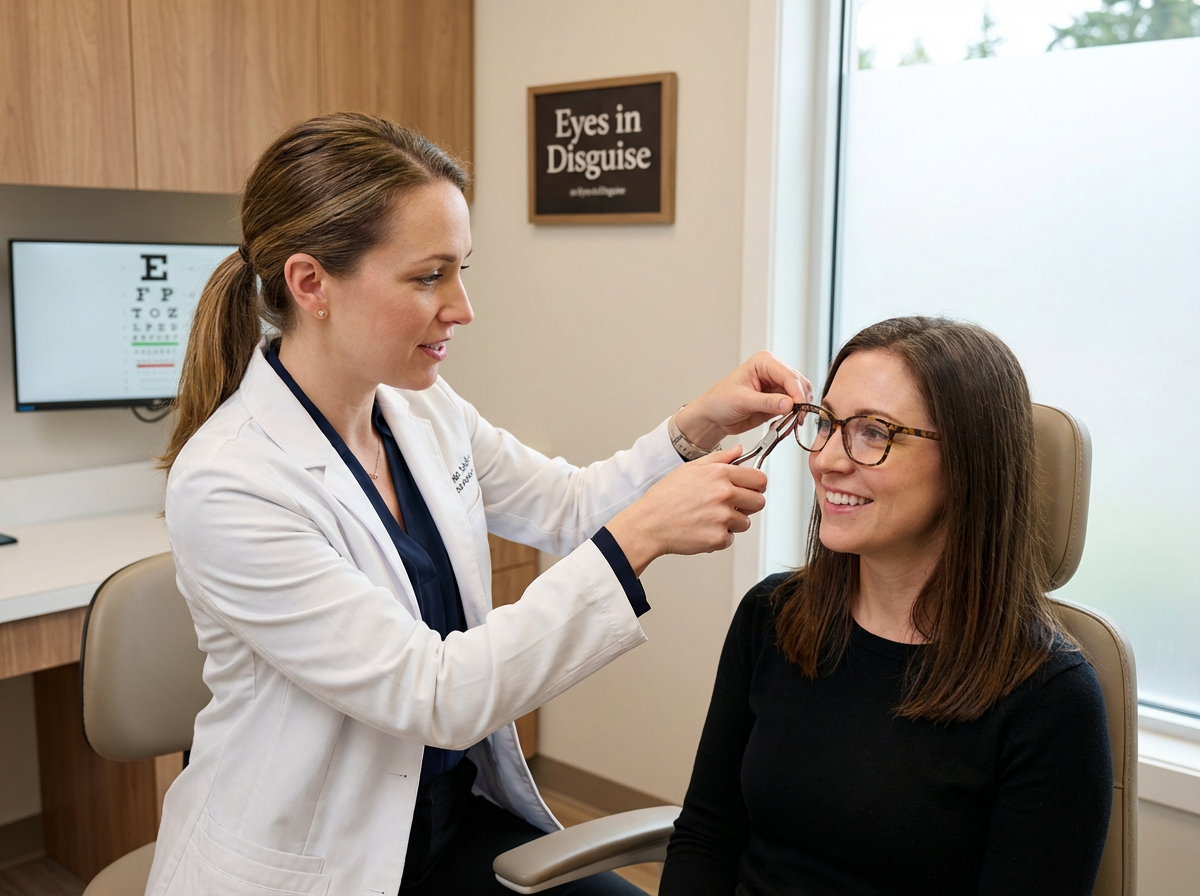
At Eyes in Disguise, we schedule follow-up appointments within 1-2 weeks of dispensing new glasses, especially for progressives or significant prescription changes.
We'll Evaluate:
1. Visual Performance
Test your vision with new glasses to confirm you're seeing 20/20 (or your best corrected acuity) at all distances.
2. Frame Fit
Measure optical center alignment, check pantoscopic tilt, verify vertex distance, and adjust nose pads and temples for comfort.
3. Your Experience
Discuss any ongoing symptoms, identify problem activities (driving, stairs, computer work), and assess adaptation progress.
4. Lens Zones (for progressives)
Verify you're finding and using the correct zones for each distance. We'll practice techniques if needed.
5. Prescription Verification
If symptoms suggest a possible error, we re-check the lenses to confirm they match your prescription.
Possible Outcomes
All clear:You're adapting normally; continue full-time wear for another week and check in if issues arise.
Minor adjustments needed:Frame fit tweaks resolve most remaining discomfort.
Lens design modification:We may recommend different progressive corridor lengths or lens designs better suited to your lifestyle.
Prescription refinement:Occasionally, a small prescription adjustment eliminates persistent blur or strain.
Long-Term Care: Keeping Your Glasses Working Perfectly
Once you're fully adjusted, proper maintenance ensures continued comfort and clarity.
Daily Maintenance
Clean lenses daily(morning and evening minimum)
Use only microfiber cloths(wash cloths weekly)
Avoid extreme temperatures(don't leave in hot cars or on heaters)
Store in hard casewhen not wearing
Regular Professional Care
Every 3-4 months:
Bring glasses in for professional cleaning, screw tightening, and alignment checks. Frames naturally loosen over time—small adjustments prevent bigger problems.
Annually:
Comprehensive eye exam to ensure prescription remains accurate. Vision changes gradually; you may not notice blur until it's significant.
As needed:
Any time glasses feel uncomfortable, sit crooked, or vision seems less clear than usual.
Signs Your Glasses Need Replacement
Scratched lensesthat interfere with vision despite cleaning
Bent framesthat can't be adjusted back to proper alignment
Stretched-out framesthat constantly slide down
Coating deterioration(peeling, hazing)
Prescription changes(typically every 1-3 years for adults)
The Bottom Line: Persistence Pays Off
Adjusting to new glasses—especially progressives or significant prescription changes—requires patience, but the payoff is clear, comfortable vision that supports your active San Francisco lifestyle. Whether you're navigating Muni, coding for hours, or hiking the Presidio, properly adjusted glasses become an invisible tool that just works.
Remember: discomfort in the first week is normal and temporary. Most adjustment issues resolve with consistent wear, proper frame fit, and realistic expectations. If problems persist beyond two weeks, we're here to troubleshoot and find solutions.
Your eyes and brain are remarkably adaptable. Give them the time they need, follow the strategies in this guide, and soon you'll forget you're even wearing glasses—which is exactly how it should be.
Struggling with new glasses or have questions about adjustment?
Schedule a follow-up appointment with Dr. Michelle Blas at Eyes in Disguise. Call(415) 474-5321or visiteyesindisguise.comto book your complimentary adjustment and fitting check.
About the Author
Dr. Michelle Blas, OD, has dedicated her 30-year optometry career to providing exceptional vision care at Eyes in Disguise in San Francisco's Cow Hollow neighborhood. Board-certified with extensive training in pediatric optometry and myopia control, Dr. Blas serves families throughout San Francisco including Pacific Heights, the Marina District, Russian Hill, and the Presidio. She combines evidence-based medical care with personalized service, helping clients navigate eye health challenges with confidence and clarity.
FAQ SECTION(8 Questions)
1. How long should I wait before deciding my new glasses aren't working?
Give your new glasses at least 7-10 days of consistent, full-time wear before concluding they aren't working. Most adjustment symptoms peak in the first 2-3 days and steadily improve. For progressive lenses, wait a full 14 days. However, if symptoms are severe from day one (extreme dizziness, nausea, sharp headaches) or vision is clearly worse than with old glasses, contact us within 48-72 hours—this suggests a possible fitting or prescription issue rather than normal adjustment.
2. Can I wear my new glasses part-time while I adjust, or do they need to be full-time?
Full-time wear from day one produces the fastest, most successful adjustment. Switching between old and new glasses confuses your visual system and prolongs—or even prevents—adaptation. The only exception: if you experience severe symptoms (nausea, extreme dizziness, inability to function), you can take short breaks with old glasses while we troubleshoot the issue. But for normal adjustment discomfort, commit to full-time wear and power through the first week.
3. Why do my new progressives make stairs feel dangerous?
Progressive lenses have the near-vision zone in the lower portion, which blurs distant objects like stairs when you look down. The solution: when descending stairs, tilt your chin UP slightly (counterintuitive, but correct) to look through the distance zone at the top of the lens. Use handrails the first week until this becomes automatic. Most people adapt within 5-7 days and navigate stairs confidently. If issues persist beyond two weeks, you may need a different progressive design with a shorter corridor.
4. My new prescription is only slightly different—why is adjustment so difficult?
Even a small prescription change (0.25 to 0.50 diopters) can cause noticeable adjustment symptoms because your visual system is highly sensitive. Additionally, if you changed frame styles, the new frames may position lenses at a different vertex distance (distance from eye to lens) or pantoscopic tilt (frame angle), altering how you see through them. Lens material changes (switching from polycarbonate to high-index, for example) can also affect peripheral vision. These small variables add up, causing more adjustment than the prescription change alone suggests.
5. Can I speed up adjustment with exercises or eye training?
There's no scientifically proven "exercise" that shortens adjustment time, but you can optimize the process: 1) Wear glasses consistently without breaks, 2) Practice specific tasks that feel challenging (like reading with progressives) for 10-15 minutes multiple times daily, 3) Ensure proper frame fit (most "adjustment" issues are actually fit problems), 4) Follow the 20-20-20 rule to prevent fatigue. Your brain adapts through exposure and repetition—the more you wear them, the faster you adjust.
6. Why do I see better with my new glasses at the eye doctor than at home?
Exam rooms have controlled lighting, minimal visual distractions, and you're seated still while looking at fixed targets. At home, you're navigating variable lighting, moving through spaces, switching between distances, and performing real-world tasks—all of which reveal adjustment challenges not apparent during the static eye exam. This is completely normal. Your vision will improve as you adapt to real-world conditions. If home vision remains significantly worse after 7-10 days, schedule a follow-up to verify prescription and frame fit.
7. Will I need to adjust again if I get the same prescription with different frames?
Yes, but adjustment will be much faster—typically 1-3 days instead of a full week. Different frames change lens positioning (vertex distance, pantoscopic tilt, optical center alignment), affecting how you see through the lenses even with an identical prescription. Frames with very different shapes, sizes, or bridge heights require more adaptation. Staying with a similar frame style minimizes this. If you're moving from metal to plastic frames or dramatically changing size, expect a brief re-adjustment period.
8. Should I continue wearing glasses that still feel wrong after two weeks?
No. While most people fully adjust within 7-14 days, persistent discomfort, blur, or strain after two weeks indicates a problem requiring professional evaluation—not continued suffering. Contact Eyes in Disguise for a follow-up. Possible causes include incorrect prescription, improper frame fit, unsuitable lens design for your needs, or (rarely) an underlying eye condition that emerged since your exam. We'll identify and resolve the issue so you're comfortable and seeing clearly.
