Astigmatism: Symptoms, Causes and Correction Options
Everything You Need to Know About Astigmatism Symptoms, Correction Options, and Living Your Best Life with This Common Vision Condition
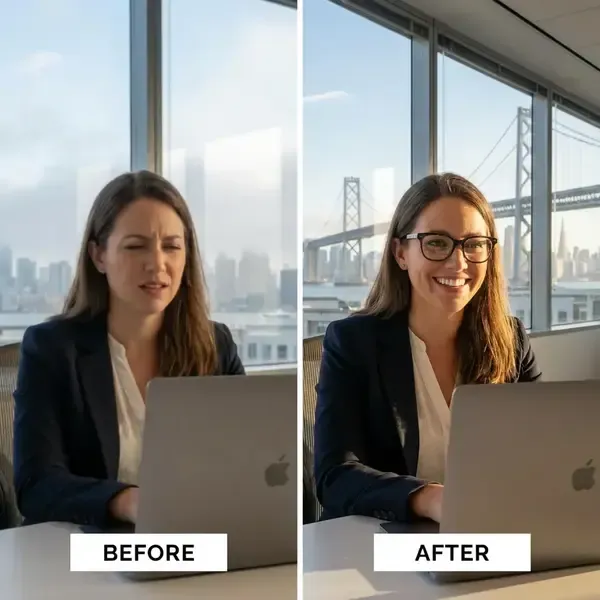
When Rachel, a 35-year-old graphic designer from Pacific Heights, finally came in for an eye exam after months of squinting at her monitor and nursing daily headaches, she was surprised by her diagnosis: astigmatism. "I thought I just needed reading glasses," she told Dr. Blas. "I didn't realize my blurry vision had an actual name—or that it was treatable."
Rachel's experience is remarkably common. Astigmatism affects approximately 1 in 3 Americans, yet many people live with blurred vision, eye strain, and headaches for years without realizing there's a straightforward explanation—and effective solutions.Cleveland Clinic
If you've been told you have astigmatism, or suspect your vision issues might be related to this condition, this guide will help you understand what's happening with your eyes, why it affects your daily life, and what correction options can restore clear, comfortable vision.
What Is Astigmatism? The Science Behind Blurry Vision
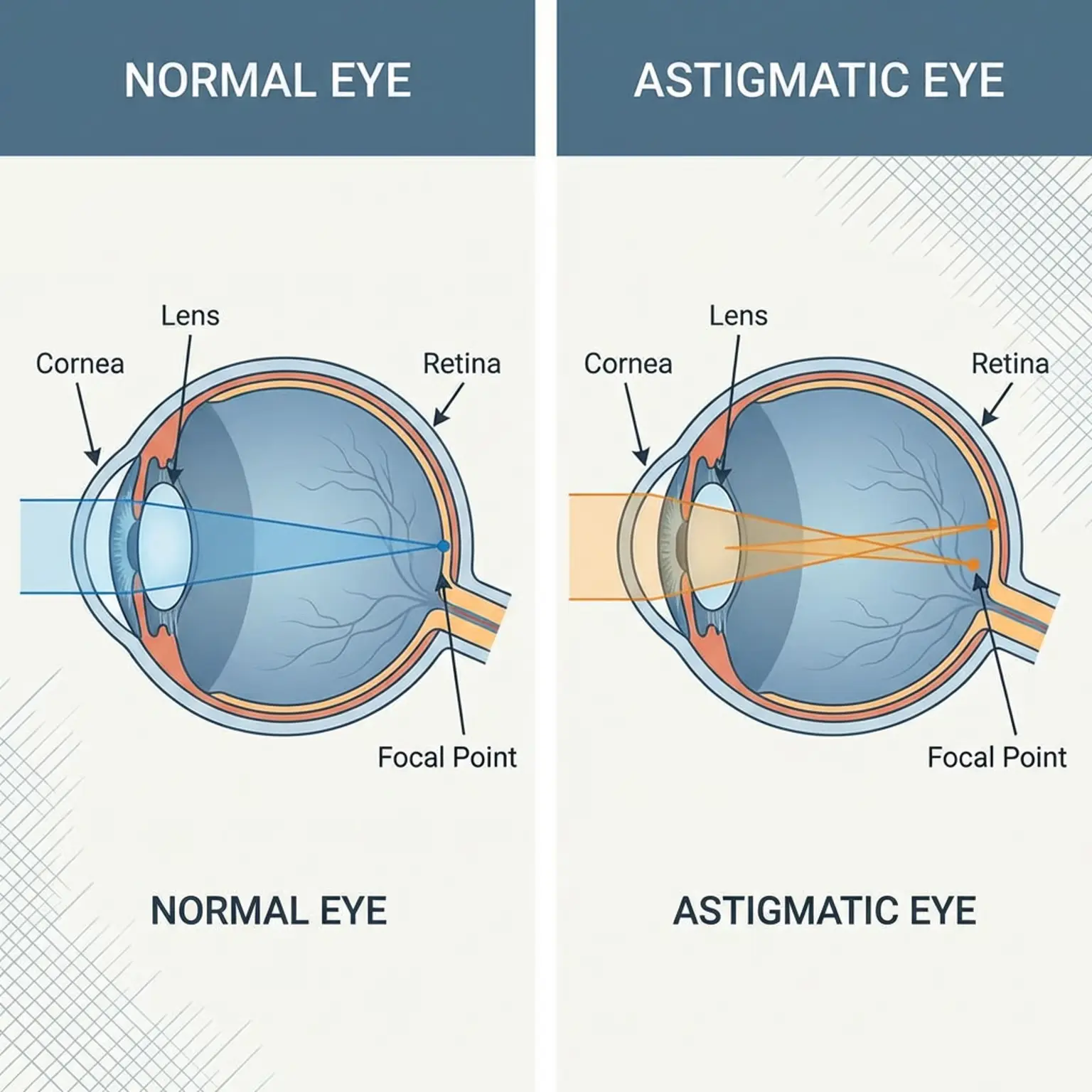
Astigmatism is a refractive error—a vision condition caused by how light bends (refracts) as it enters your eye. To understand astigmatism, it helps to know what "normal" vision looks like:
Normal Vision vs. Astigmatism
In an eye without astigmatism:
The cornea (clear front surface) and lens are smoothly curved, like a perfectly round basketball
Light entering the eye focuses to a single point on the retina
The result: sharp, clear vision at all distances (assuming no other refractive errors)
In an eye with astigmatism:
The cornea or lens has an irregular curve—more like a football or rugby ball than a basketball
Light entering the eye focuses to multiple points, either in front of or behind the retina
The result: blurred or distorted vision at all distances
The uneven curvature causes light rays to bend unevenly, creating multiple focal points instead of one. Your brain receives a blurred or stretched image, forcing your eyes to work harder to achieve clear focus.American Academy of Ophthalmology
Types of Astigmatism
Corneal Astigmatism:
The most common type, caused by an irregularly shaped cornea. This accounts for most astigmatism cases.
Lenticular Astigmatism:
Caused by an irregularly shaped lens inside the eye. Less common than corneal astigmatism.
Regular Astigmatism:
The two principal meridians (the steepest and flattest curves) are perpendicular to each other—either vertical/horizontal or diagonal. Regular astigmatism is easily corrected with glasses or standard toric contact lenses.
Irregular Astigmatism:
The principal meridians are not perpendicular, or the corneal surface has multiple irregular curves. This type often results from injury, eye surgery, or conditions like keratoconus. Irregular astigmatism typically requires specialty contact lenses (scleral or rigid gas permeable) for optimal correction.American Academy of Ophthalmology EyeNet
With-the-Rule vs. Against-the-Rule:
With-the-rule: The vertical meridian is steeper (most common in younger patients)
Against-the-rule: The horizontal meridian is steeper (more common with aging)
Recognizing Astigmatism: Signs and Symptoms
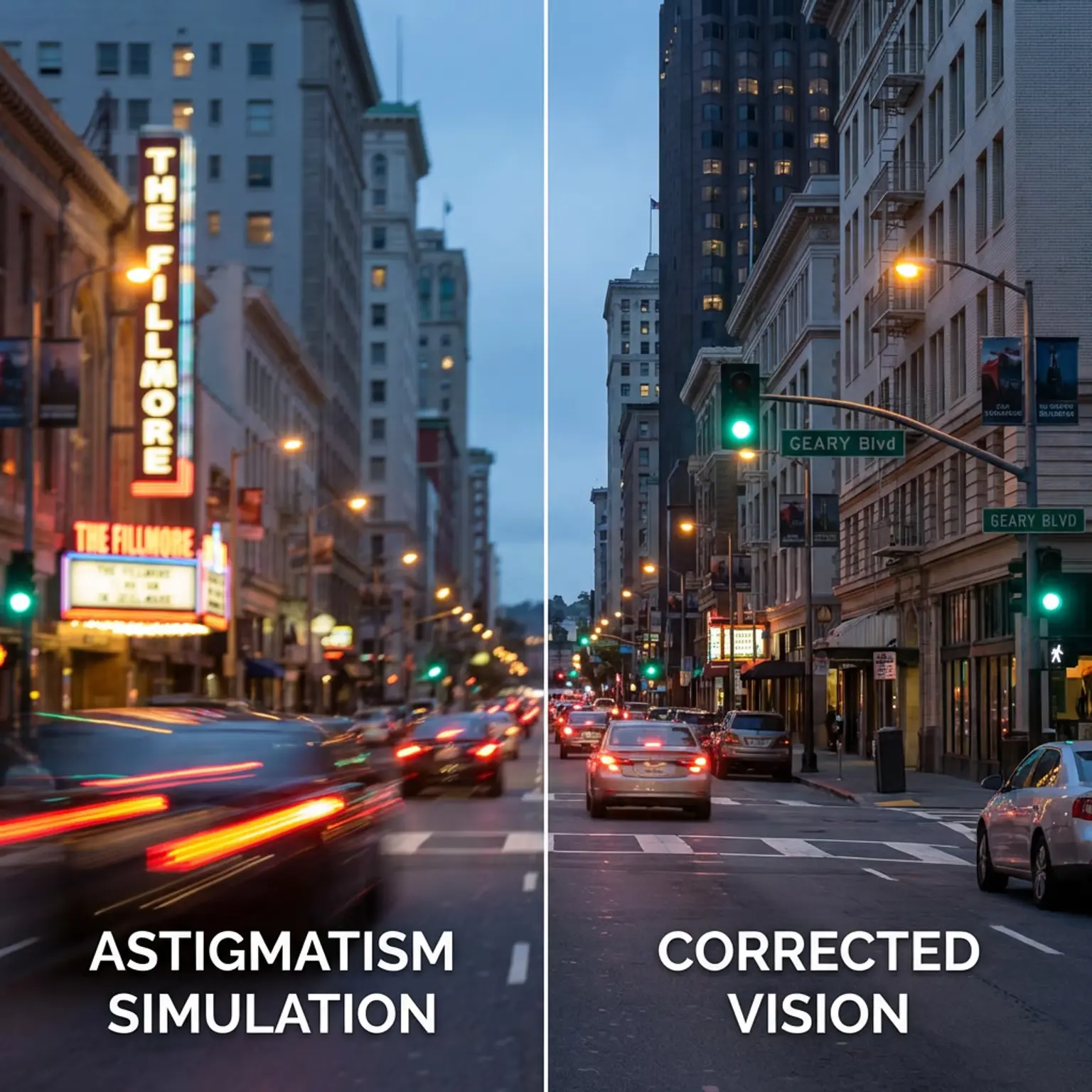
Astigmatism symptoms range from mild to significant, depending on the severity of your condition. Many people adapt to mild astigmatism without realizing their vision could be sharper.
Common Symptoms
Blurred or Distorted Vision:
Objects appear fuzzy, stretched, or slightly wavy at all distances—near and far. Unlike nearsightedness (blurry distance) or farsightedness (blurry near), astigmatism affects vision comprehensively.
Eye Strain and Fatigue:
Your eyes work overtime trying to compensate for the irregular focus. After reading, computer work, or driving, your eyes feel tired and heavy.
Headaches:
Frequent headaches, especially after prolonged visual tasks, result from the constant effort your eye muscles exert to focus. Many people attribute these to stress or lack of sleep without connecting them to vision.Curtis Frank, OD
Squinting:
You instinctively squint to create a smaller aperture, which temporarily sharpens focus by reducing light scatter. Chronic squinting can lead to wrinkles and facial muscle tension.
Difficulty with Night Vision:
Astigmatism exaggerates glare and halos around lights—streetlights, car headlights, and illuminated signs appear to have starbursts or streaks. Night driving becomes particularly challenging. Our post on halos and glare when driving at night covers astigmatism alongside the other common causes, such as cataracts and dry eye.
Double Vision (Monocular Diplopia):
In more severe cases, you might see ghosting or overlapping images from a single eye (close the other eye—if you still see double, it's monocular diplopia from astigmatism).
Reading Difficulties:
Letters and words may appear tilted, stretched, or jumbled, making sustained reading uncomfortable and slow.
What Causes Astigmatism?
Genetics and Development
Most astigmatism is congenital—present from birth and inherited from your parents. If one or both parents have astigmatism, there's a higher likelihood you will too. The irregular corneal shape develops during fetal eye formation.
Age-Related Changes
Astigmatism can develop or change as you age:
The cornea may gradually flatten or steepen
The crystalline lens changes shape, potentially introducing lenticular astigmatism
"Against-the-rule" astigmatism often increases after age 50
Eye Conditions and Injury
Certain conditions and events can cause or worsen astigmatism:
Keratoconus:A progressive condition where the cornea thins and bulges into a cone shape, causing severe irregular astigmatism
Eye surgery:LASIK, cataract surgery, or corneal transplants can temporarily or permanently alter corneal shape
Eye injury or trauma:Scarring can create irregular corneal surfaces
Pterygium:A growth on the cornea can distort its shape
Eyelid Pressure
Chronic rubbing or pressure on the cornea (from conditions like ptosis or frequent eye rubbing) can gradually change its shape, inducing astigmatism.
How Astigmatism Affects Your Daily Life in San Francisco
Tech Industry Challenges
San Francisco's tech-heavy workforce faces unique astigmatism challenges:
Extended screen time amplifies eye strain and headaches
Multiple monitors at varying distances demand constant refocusing
Late-night coding sessions exacerbate night vision issues and glare sensitivity
Video conferences require sharp intermediate vision—exactly where uncorrected astigmatism causes blur
Commuting and Driving
San Francisco's urban driving conditions are particularly difficult with uncorrected astigmatism:
Nighttime glare from streetlights and oncoming traffic creates starbursts and halos
Tunnel transitions (Broadway Tunnel, Yerba Buena Tunnel) demand rapid light adaptation while navigating blur and glare
Fog and rain scatter light, intensifying the visual distortion astigmatism creates
Hill gradients require precise depth perception, which astigmatism can compromise
Outdoor Activities
Whether you're hiking the Presidio, cycling the Embarcadero, or running through Golden Gate Park:
Variable lighting (fog to sun transitions) makes astigmatism symptoms more noticeable
Depth perception challenges can affect trail navigation and spatial awareness
Activity-related eye strain compounds throughout the day without proper correction
Professional and Social Life
Reading presentations and documents becomes exhausting
Recognizing faces from a distance can be difficult
Reading menus in dim restaurants requires squinting or phone flashlights
General fatigue from constant visual effort affects mood and energy
Astigmatism Correction Options: Finding Your Perfect Solution
The good news: astigmatism is highly correctable. The key is finding the option that matches your lifestyle, visual needs, and comfort preferences.
1. Eyeglasses with Cylindrical Lenses
How they work:
Astigmatism-correcting glasses have "cylinder" power built into the lens prescription, compensating for the irregular corneal or lens curvature. The cylindrical lens bends light differently in different meridians, counteracting your eye's irregular shape.
Advantages:
Most straightforward correction
Immediate, predictable results
No contact with eyes (ideal for dry eye sufferers or contact lens intolerance)
Can incorporate multiple corrections (astigmatism + presbyopia in progressives)
Easy to maintain
Considerations:
Peripheral distortion with higher astigmatism correction
Weight and thickness increase with stronger prescriptions (high-index lenses minimize this)
Frame adjustments needed to maintain proper lens angle (axis alignment matters)
Can fog, get wet, or slide down your nose during activities
Best for:Anyone seeking reliable, low-maintenance vision correction; people with dry eyes; those who prefer not to touch their eyes.
2. Toric Contact Lenses
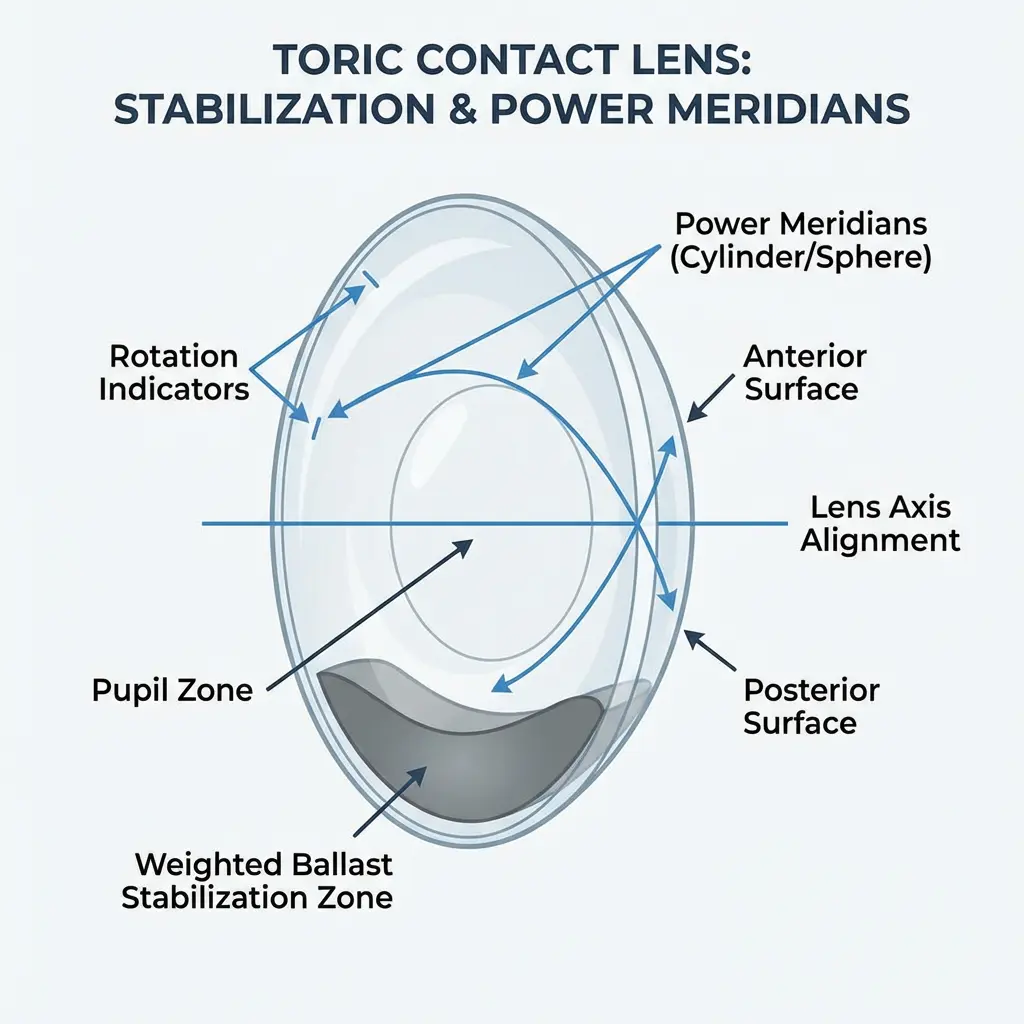
How they work:
Toric contact lenses are specifically designed to correct astigmatism. Unlike spherical lenses (round in all directions), toric lenses have different powers in different meridians and include a stabilization system to keep the lens properly oriented on your eye.
Stabilization methods:
Prism ballast:Weighted bottom edge
Thin zones:Thinner areas at top and bottom allow eyelids to hold lens in place
Truncated edge:Flat edge along the bottom
Advantages:
Natural field of view (no frame edges or peripheral distortion)
Better peripheral vision than glasses
No fogging or rain issues
Ideal for sports and active lifestyles
Available in daily disposable, bi-weekly, and monthly options
More natural appearance
Considerations:
Require consistent daily care (unless using dailies)
Fitting process is more complex than glasses—requires trial lenses
Higher cost than non-toric contacts
Rotation on the eye can temporarily blur vision (modern designs minimize this)
Requires comfort with touching your eyes
Best for:Active individuals, athletes, people who dislike glasses aesthetics, those seeking wider peripheral vision.
PMC Study on Toric Contact Lens Effectiveness
3. Rigid Gas Permeable (RGP) Contact Lenses
How they work:
RGP lenses are firm, allowing them to hold their shape on the eye. The tear layer between lens and cornea creates a smooth refractive surface, effectively neutralizing irregular corneal astigmatism.
Advantages:
Superior vision correction, especially for irregular astigmatism
Excellent oxygen permeability (healthier for corneas)
Durable—lasts 1-2 years with proper care
Less protein buildup than soft lenses
Cost-effective long-term
Considerations:
Longer adaptation period (1-2 weeks of awareness/discomfort)
Can dislodge more easily than soft lenses (less ideal for contact sports)
Requires daily cleaning and storage
More noticeable sensation initially
Best for:Moderate to severe astigmatism; irregular astigmatism; people who've tried soft torics without success; those prioritizing sharpest possible vision.
4. Scleral Contact Lenses
How they work:
Large-diameter lenses that vault over the entire cornea and rest on the sclera (white part of the eye). A fluid reservoir between lens and cornea corrects irregular astigmatism while providing hydration.
Advantages:
Exceptional correction for irregular astigmatism, keratoconus, and post-surgical eyes
Very stable on the eye (don't move or rotate)
Comfortable despite rigid design (no corneal touch)
Excellent for dry eye patients
Superior vision quality
Considerations:
Require specialized fitting and follow-up
Insertion/removal learning curve
Higher cost ($400-$600+ per lens)
Daily cleaning required
Not widely available (specialty practices only)
Best for:Irregular astigmatism; keratoconus; post-LASIK or corneal transplant patients; severe dry eye with astigmatism.
5. Refractive Surgery (LASIK, PRK, SMILE)
How it works:
Laser vision correction reshapes the cornea to eliminate astigmatism permanently. Several procedures are available:
LASIK (Laser-Assisted In Situ Keratomileusis):
Creates a corneal flap, reshapes underlying tissue with excimer laser, replaces flap
Fast recovery (days to weeks)
Minimal discomfort
Can correct up to approximately -6.00D of astigmatism
PRK (Photorefractive Keratectomy):
Surface laser treatment (no flap)
Longer recovery (weeks)
Better for thin corneas or certain professions (military, law enforcement)
Can correct moderate astigmatism
SMILE (Small Incision Lenticule Extraction):
Minimally invasive (small incision, no flap)
Fast recovery
Limited astigmatism correction (up to -5.00D cylinder)
Advantages:
Permanent correction (with stable prescriptions)
Freedom from glasses and contacts
Long-term cost savings
Lifestyle convenience
Considerations:
Requires healthy corneas and stable prescription
Not reversible
Potential side effects (dry eye, glare, halos—usually temporary)
Cost: $2,000-$4,000+ per eye
San Francisco has excellent LASIK providers; we co-manage care with trusted specialists
Best for:Adults with stable astigmatism who want permanent correction; people with active lifestyles where glasses/contacts are inconvenient.
LaserVue LASIK for Astigmatism
Living Well with Astigmatism: Daily Tips for Clearer, More Comfortable Vision
Even with correction, these strategies help minimize eye strain and optimize vision:
1. Consistent Wear of Corrective Lenses
Don't "save" your glasses or contacts for when you "really need them." Part-time wear forces your eyes to constantly readjust, increasing strain and headaches. Consistent correction allows your visual system to relax.
2. Follow the 20-20-20 Rule
Every 20 minutes of screen time, look at something 20 feet away for 20 seconds. This gives your focusing muscles a break and reduces digital eye strain—especially important with astigmatism.
3. Optimize Lighting
Proper lighting reduces the need for your eyes to strain. Use task lighting for reading and desk work; avoid glare on screens by positioning monitors perpendicular to windows.
4. Keep Lenses Clean
Smudges, dust, and fingerprints degrade visual quality—problematic when you already have astigmatism. Clean glasses and contacts regularly using proper solutions and microfiber cloths.
5. Stay Hydrated
Dehydration exacerbates dry eye, which compounds astigmatism symptoms. San Francisco's microclimates—especially dry, windy areas like the Embarcadero—demand conscious hydration and artificial tears if needed.
6. Schedule Annual Eye Exams
Astigmatism can change over time. Regular exams ensure your correction remains accurate and catch any emerging eye health issues early.Beach Cities Optometry
7. Reduce Nighttime Glare

If night driving is difficult:
Keep windshields spotlessly clean (inside and out—dirt scatters light)
Use anti-reflective coatings on glasses
Consider prescription sunglasses with polarization for daytime glare
Avoid looking directly at oncoming headlights
8. Communicate with Your Eye Care Team
If your correction isn't providing comfortable, clear vision throughout the day, speak up. Adjustments, different lens designs, or alternative correction methods might be needed.
What to Expect at Your Eyes in Disguise Astigmatism Consultation
At our Cow Hollow practice, Dr. Michelle Blas uses advanced diagnostic technology to precisely measure your astigmatism and develop a personalized correction plan.
Comprehensive Astigmatism Evaluation
1. Refraction Testing:
We determine the exact sphere (nearsightedness/farsightedness), cylinder (astigmatism amount), and axis (astigmatism direction) needed for optimal correction.
2. Corneal Topography:
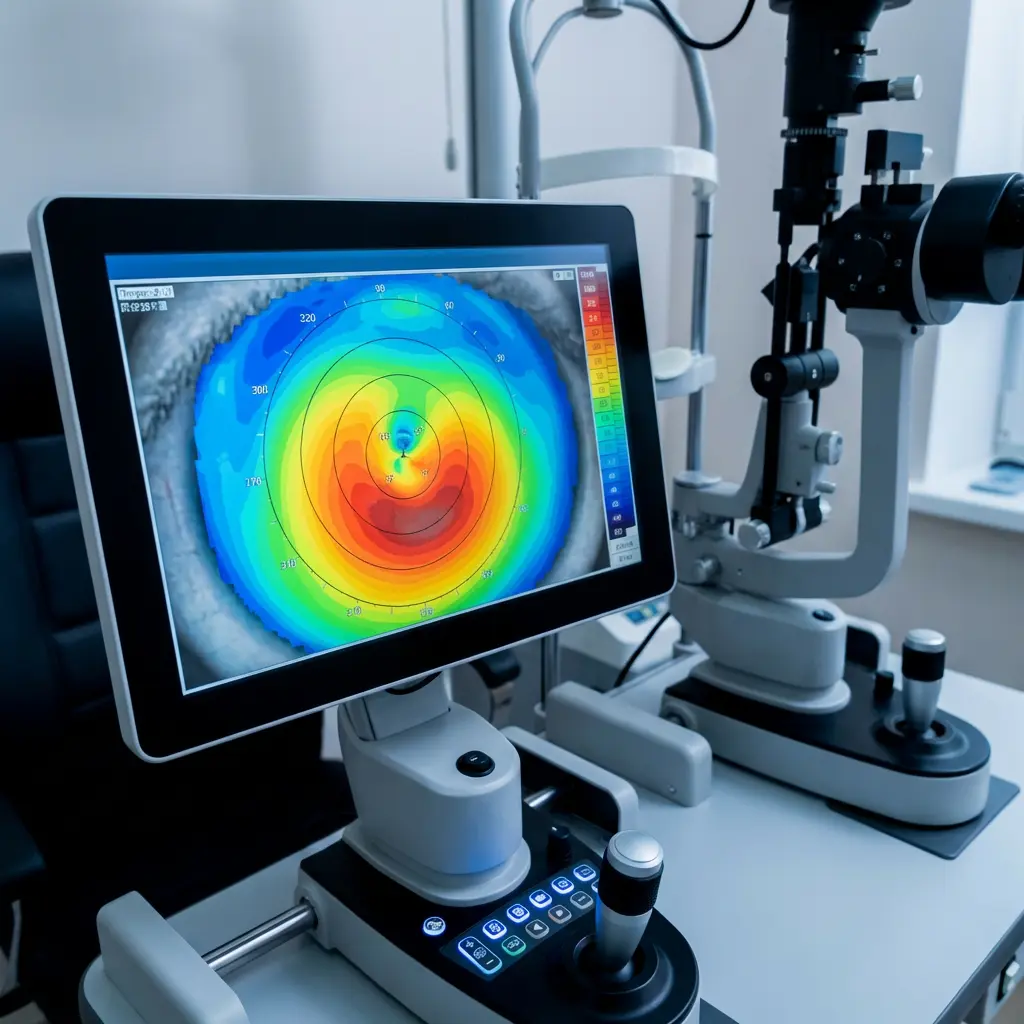
Digital mapping creates a detailed 3D image of your corneal surface, revealing the shape, curvature, and any irregularities. This technology is essential for detecting keratoconus and fitting specialty contact lenses.
3. Keratometry:
Measures the curvature of your cornea in specific meridians, providing precise data for astigmatism correction.
4. Visual Acuity Testing:
We assess how well you see at various distances with and without correction, establishing a baseline and goals.
5. Eye Health Examination:
Comprehensive evaluation of corneal health, lens clarity, retinal health, and overall eye structure to rule out conditions causing or worsening astigmatism.
Personalized Correction Planning
After diagnosis, we discuss:
Your lifestyle needs:Work demands, hobbies, sports, screen time
Correction preferences:Glasses, contacts, or combination approach
Trial options:For contacts, we provide trial lenses to ensure comfort and vision before ordering your supply
Cost and insurance:We review coverage and payment options
Follow-up care:Schedule for contact lens follow-ups or glasses adjustments
Astigmatism Myths We Hear Every Day (and the Truth)
Myth: "Astigmatism means you have a diseased or damaged eye."
Truth:Astigmatism is a refractive error—a difference in shape, not a disease. Most cases are genetic and present from birth. Your eyes are healthy; they just focus light differently.
Myth: "Astigmatism will get worse if I wear glasses."
Truth:Glasses don't change your eye shape or worsen astigmatism. Wearing proper correction actually reduces strain and can prevent associated headaches and fatigue.
Myth: "You can't wear contact lenses if you have astigmatism."
Truth:Toric contact lenses specifically correct astigmatism. Modern toric designs are comfortable, stable, and available in daily disposables, making contact lens wear very accessible.
Myth: "Astigmatism only affects adults."
Truth:Astigmatism is often present from birth. Regular eye exams can detect it early, ensuring proper correction during critical visual development years (though this blog focuses on adult care).
Myth: "Reading or screen time causes astigmatism."
Truth:Astigmatism is structural—caused by corneal or lens shape. Screen time doesn't create astigmatism, though it can make uncorrected astigmatism symptoms (eye strain, headaches) more noticeable.
When to Schedule Your Astigmatism Evaluation
You should book a comprehensive eye exam with Dr. Blas if you:
Experience frequent headaches, especially after reading, computer work, or driving
Notice blurred or distorted vision at any distance
Find yourself squinting often to see clearly
Have difficulty with night driving (glare, halos, starbursts around lights)
Feel eye strain or fatigue by afternoon/evening
Haven't had an eye exam in 2+ years
Are interested in contact lenses and haven't tried toric lenses
Want to explore LASIK or other refractive surgery options
Notice changes in your vision or prescription effectiveness
What to bring:
Current glasses (even if you think the prescription is outdated)
Contact lens boxes (if you wear contacts) to reference prescription
List of medications and any eye-related symptoms you've noticed
Insurance information
The Bottom Line: Astigmatism Doesn't Have to Hold You Back

Astigmatism is one of the most common and correctable vision conditions. With accurate diagnosis, proper correction, and ongoing care, you can enjoy crisp, comfortable vision whether you're working on Zoom calls from your Marina apartment, driving through the Presidio at dusk, or exploring San Francisco's trails and neighborhoods.
The key is finding the correction method that fits your life—glasses for simplicity, contact lenses for freedom, or surgery for permanence. At Eyes in Disguise, we don't believe in one-size-fits-all solutions. We take time to understand your vision challenges, lifestyle needs, and personal preferences to create a correction plan that works.
If blurry vision, headaches, or eye strain have become your norm, it's time to discover what clear, comfortable vision feels like. Astigmatism is manageable—and you deserve to see your world in sharp focus.
Ready to correct your astigmatism and experience clearer, more comfortable vision?
Schedule your comprehensive eye exam and astigmatism evaluation with Dr. Michelle Blas at Eyes in Disguise. Call (415) 474-5321or visit eyesindisguise.com to book your appointment today.
About the Author
Dr. Michelle Blas, OD, has dedicated her 30-year optometry career to providing exceptional vision care at Eyes in Disguise in San Francisco's Cow Hollow neighborhood. Board-certified with extensive training in pediatric optometry and myopia control, Dr. Blas serves families throughout San Francisco including Pacific Heights, the Marina District, Russian Hill, and the Presidio. She combines evidence-based medical care with personalized service, helping clients navigate eye health challenges with confidence and clarity.
FAQ SECTION
1. Can astigmatism be cured, or is it permanent?
Astigmatism itself is typically a permanent structural characteristic of your eye—your cornea or lens has an irregular shape that doesn't spontaneously become round. However, astigmatism can be fully corrected with glasses, contact lenses, or refractive surgery (LASIK, PRK). While correction doesn't "cure" the underlying shape, it restores clear vision. In rare cases, astigmatism can change over time due to aging, eye conditions, or surgery, but the original structural cause remains.
2. Is astigmatism correction in glasses noticeably different from regular lenses?
For mild to moderate astigmatism, most people adapt quickly and don't notice a significant difference. Higher astigmatism corrections may cause initial peripheral distortion or a "fishbowl" effect for the first few days while your brain adjusts. Proper frame fitting and lens positioning are critical—the axis of the cylindrical correction must align precisely. Premium lens designs (digital freeform lenses) minimize distortion. If you experience persistent discomfort or distortion, your prescription or frame fit may need adjustment.
3. Why do my toric contact lenses sometimes blur suddenly?
Toric lenses rely on proper orientation to correct astigmatism effectively. If the lens rotates on your eye, vision blurs until it settles back into position. Common causes: dry eyes (reduces lens stability), lens fit issues (too tight or loose), blinking or rubbing your eyes, or lens design mismatch. Modern toric lenses have improved stabilization, but occasional rotation can still happen. If blurring is frequent, schedule a contact lens refit—a different brand or design may stay more stable on your eyes.
4. Can I get astigmatism correction in progressive lenses?
Absolutely. Progressive lenses can incorporate astigmatism correction throughout all zones (distance, intermediate, near). The design is more complex than single-vision astigmatism correction or standard progressives, so premium digital progressives often provide the widest clear zones and fastest adaptation. Expect a brief adjustment period (3-7 days) as your eyes learn to use the corridor. Proper measurements and frame selection are essential for success.
5. Is astigmatism related to other eye conditions?
Astigmatism itself is usually an isolated refractive error. However, certain conditions cause or worsen astigmatism: keratoconus (progressive corneal thinning and bulging), pterygium (growth on the cornea), corneal scarring from injury or infection, and eyelid abnormalities (ptosis creating pressure). Regular eye exams can detect these conditions early. If your astigmatism changes suddenly or significantly, further evaluation is needed to rule out underlying issues.
6. How much does astigmatism correction cost?
Costs vary by correction method: Glasses with astigmatism correction: $150-$800+ depending on frame choice and lens options (basic single-vision to premium progressives). Toric contact lenses: $300-$800/year (annual supply), typically $50-$150 more per year than non-toric lenses. LASIK/PRK: $2,000-$4,000+ per eye, often not covered by insurance but may qualify for FSA/HSA funds. Many vision insurance plans cover glasses or contacts partially, and we help maximize your benefits.
7. Will my astigmatism get worse over time?
For most people, astigmatism remains stable after the early 20s, though minor changes can occur. "Against-the-rule" astigmatism (horizontal meridian steeper) often develops or increases after age 50 due to eyelid changes and corneal flattening. Progressive conditions like keratoconus cause worsening astigmatism, but these are relatively rare. Annual eye exams track changes and ensure your correction stays accurate. Sudden astigmatism changes warrant immediate evaluation to rule out injury or disease.
8. Can I drive safely with uncorrected astigmatism?
Legally, it depends on your visual acuity. Many states require 20/40 vision or better for an unrestricted driver's license. Uncorrected astigmatism often causes significant glare, halos, and blur—especially at night—making driving less safe even if you technically meet legal minimums. Corrected astigmatism dramatically improves road visibility, depth perception, and reaction time. For your safety and others', we strongly recommend wearing proper correction while driving.
