Navigating Eyeglass Lens Options: Your Complete San Francisco Guide to Choosing the Perfect Lenses for Your Lifestyle
Understanding Lens Materials, Coatings, Designs, and Technologies to Make the Best Choice for Your Vision and Budget
When David, a 52-year-old architect from Marina District, came into Eyes in Disguise to order new glasses, he was overwhelmed. "The optician asked if I wanted high-index, polycarbonate, or Trivex lenses, then mentioned anti-reflective coating, blue light filtering, photochromic options, and something called 'digital freeform' progressives," he told Dr. Blas. "I just wanted to see clearly—I had no idea there were so many choices."
David's confusion is understandable. Modern eyeglass lenses involve dozens of variables: materials, thicknesses, coatings, tints, and design technologies. Without guidance, it's impossible to know which options are essential, which are nice-to-have, and which are marketing gimmicks you can skip.
This guide breaks down every lens option available at Eyes in Disguise, explains what each does (in plain English), and helps San Francisco residents choose lenses that match their lifestyle, budget, and visual needs—without paying for features they don't need.
Lens Materials: The Foundation of Your Glasses
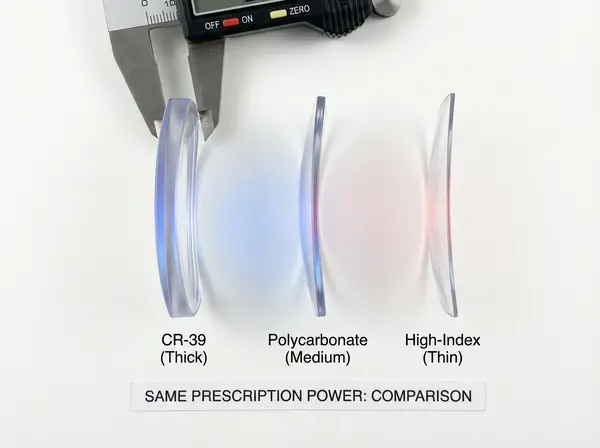
The material your lenses are made from affects weight, thickness, durability, optical clarity, and cost. Here's what you need to know about each option:
1. Standard Plastic (CR-39)
What it is:The original plastic lens material, introduced in the 1940s and still widely used today.
Advantages:
Excellent optical clarity (crisp, distortion-free vision)
Lowest cost ($50-$100 for single-vision lenses)
Accepts tints and coatings well
Scratch-resistant surface (better than polycarbonate without coating)
Disadvantages:
Thickest and heaviest option (noticeable with stronger prescriptions)
Can break or shatter upon impact (not recommended for sports or active lifestyles)
No built-in UV protection (requires coating)
Best for:Mild prescriptions (-2.00 to +2.00), budget-conscious buyers, people prioritizing optical quality over weight, backup glasses.
Not ideal for:Strong prescriptions (lenses will be thick), children, athletes, or anyone needing impact resistance.
2. Polycarbonate
What it is:Impact-resistant plastic originally developed for aerospace applications, now the standard for safety and children's eyewear.
Advantages:
Impact-resistant:10x more impact-resistant than standard plastic—virtually shatterproof
Built-in 100% UV protection (inherent to the material)
Lightweight (about 20% lighter than CR-39)
Thinner than standard plastic (about 20% thinner)
Ideal for rimless and semi-rimless frames (won't crack at drill holes)
Disadvantages:
Lower optical clarity than CR-39 or high-index (minor chromatic aberration—color fringing at lens edges)
Soft surface scratches easily (requires scratch-resistant coating)
Slightly more expensive than CR-39 ($100-$200 for single-vision)
Best for:Active lifestyles, sports, safety glasses, rimless frames, anyone prioritizing durability over absolute optical perfection, strong prescriptions where impact resistance is important.
San Francisco context:Ideal for cyclists, runners, hikers, and anyone with active Bay Area lifestyles.
3. Trivex
What it is:Newer material combining the impact resistance of polycarbonate with superior optical clarity approaching CR-39.
Advantages:
Best optical clarity among impact-resistant materials (minimal chromatic aberration)
Impact-resistant like polycarbonate (meets same safety standards)
Built-in 100% UV protection
Lightweight (lighter than polycarbonate despite slightly thicker profile)
Excellent for drilling (ideal for rimless frames)
Disadvantages:
Slightly thicker than polycarbonate for equivalent prescription
More expensive ($150-$250 for single-vision)
Less widely available (not all labs stock it)
Best for:People wanting impact resistance AND superior optical quality, rimless frame wearers, those with moderate prescriptions who prioritize clarity, pilots and anyone needing precision vision.
When to choose Trivex over polycarbonate:If optical clarity is critical for your work (design, architecture, detail-oriented tasks) but you need impact resistance.
4. High-Index Plastic (1.67, 1.74)
What it is:Dense plastic materials that bend light more efficiently, allowing thinner lenses for strong prescriptions.
Advantages:
Thinnest lenses for strong prescriptions (up to 40% thinner than standard plastic)
Lighter weight despite density (reduced edge thickness reduces overall weight)
Better aesthetics (less "Coke bottle" effect)
Built-in UV protection (most high-index materials)
Disadvantages:
Higher cost ($200-$400+ for single-vision; more for progressives)
More reflective surfaces (anti-reflective coating essential—not optional)
Slightly lower impact resistance than polycarbonate/Trivex
More brittle (can chip if dropped on hard surfaces)
Index options:
1.67 index:For prescriptions -4.00 to -8.00 (or +4.00 to +6.00)
1.74 index:For prescriptions beyond -8.00 (or +6.00+)—thinnest available
Best for:Strong prescriptions (-4.00 and beyond), anyone self-conscious about thick lenses, fashion-forward frames where thin lenses look better.
Cost-benefit consideration:For mild prescriptions (-2.00 or less), high-index doesn't provide meaningful thickness reduction—you're paying extra for minimal benefit.
5. Glass (Rare Today)
What it is:Traditional lens material, now rarely used except for specific applications.
Advantages:
Best optical clarity of any material (perfect vision with zero distortion)
Extremely scratch-resistant (virtually impossible to scratch)
Thin (high-index glass available)
Disadvantages:
Heavy (significantly heavier than all plastic options)
Shatters upon impact (safety hazard)
Very expensive
Not widely available
Best for:Prescription never changes, willing to prioritize optical perfection over safety/weight, specific occupations requiring zero optical distortion.
Reality:We rarely recommend glass today—modern high-index plastics provide excellent clarity with far better safety.
Essential Lens Coatings: What You Actually Need
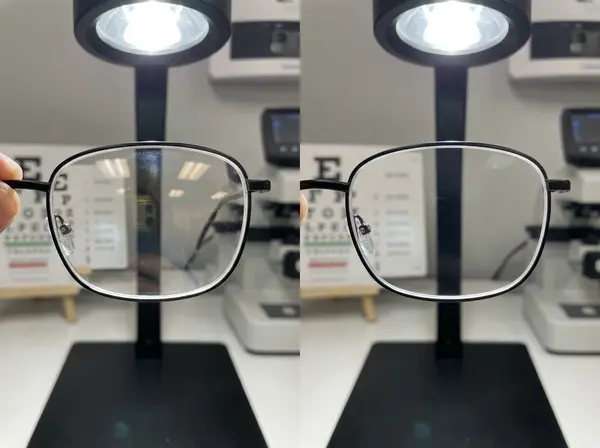
Coatings dramatically improve lens performance, comfort, and longevity. Some are essential; others are optional depending on your needs.
1. Anti-Reflective (AR) Coating
What it does:Eliminates reflections from lens surfaces (front and back), allowing more light to pass through to your eyes.
Benefits:
Clearer vision:Especially at night (eliminates glare from headlights, streetlights)
Better appearance (others see your eyes, not reflections in your lenses)
Reduced eye strain from computer work
Improved contrast and color perception
Essential for high-index lenses (which are naturally very reflective)
Quality tiers:
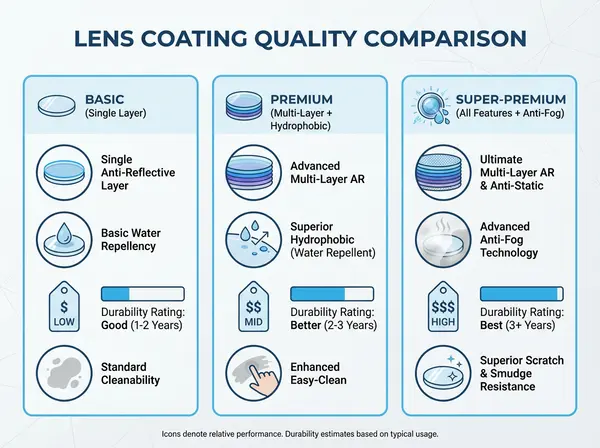
Basic AR:Single-layer coating; provides glare reduction but limited durability ($40-$80)
Premium AR:Multi-layer coating with hydrophobic (water-repelling) and oleophobic (oil-repelling) top coats; easier to clean, more durable ($80-$150)
Super-premium AR:Add scratch resistance, anti-static, and anti-fog properties ($150-$200+)
Our recommendation:Premium AR is worth the investment for most people. Basic AR wears off faster; super-premium is only necessary for extreme environments.
Essential for:High-index lenses, night drivers, computer users, anyone over 40 (pupils dilate less with age, making glare more problematic).
2. Scratch-Resistant Coating
What it does:Hardens lens surface to resist scratches from daily wear.
Reality check:No coating makes lenses "scratch-proof"—only scratch-resistant. Proper care (microfiber cloths, cases) matters more than coating quality.
Built-in vs. added:
Polycarbonate and Trivex: Requires separate scratch coating (soft material)
High-index: Often includes scratch coating as part of AR package
CR-39: Inherently more scratch-resistant but still benefits from coating
Cost:Usually bundled with AR coating ($20-$50 standalone)
Our recommendation:Always add this, especially for polycarbonate lenses.
3. UV Protection Coating
What it does:Blocks 100% of UVA and UVB rays that can damage eyes over time.
Built-in vs. coating:
Polycarbonate, Trivex, most high-index:UV protection is inherent to the material
CR-39 (standard plastic):Requires UV coating
Cost:$20-$40 if needed as separate coating
Our recommendation:Ensure 100% UV protection either through material or coating—this is non-negotiable for eye health.
Note:UV coating on clear lenses protects eyes; it doesn't eliminate the need for sunglasses (which protect surrounding skin and provide glare reduction).
4. Blue Light Filtering
What it does:Filters high-energy visible (HEV) blue light (400-450nm) emitted by screens and LED lighting.
The science:Blue light exposure can contribute to digital eye strain and may disrupt circadian rhythms when you're on screens before bed. Evidence for long-term retinal damage from screen exposure is limited.
Options:
Blue light coating:Applied to clear lenses; minimal yellow tint; filters 15-30% of blue light ($40-$100)
Blue light lens material:Blue-filtering pigment embedded in lens; filters 30-50% of blue light; more noticeable yellow tint ($60-$120)
Who benefits:
Extended screen time (6+ hours daily)
Difficulty sleeping after evening screen use
Tech workers, gamers, graphic designers
People sensitive to fluorescent/LED lighting
Who can skip:
Minimal screen time (<4 hours daily)
No sleep or eye strain issues
Prefer clear lenses without tint
Our recommendation:Helpful for heavy screen users, but not a substitute for good screen habits (20-20-20 rule, proper lighting, screen distance). Try it if you're curious—many people notice reduced eye fatigue.
San Francisco context:Given our tech-heavy workforce, blue light filtering is popular and often worthwhile.
5. Anti-Fog Coating
What it does:Prevents condensation from forming on lenses during temperature/humidity changes.
Who needs it:
Frequent foggers (glasses fog entering warm buildings from cold fog)
Mask wearers (medical professionals, anyone wearing masks regularly)
Cooks, baristas, anyone working with steam
Cost:$50-$100
Effectiveness:Works well initially; requires re-application or dedicated sprays after 6-12 months as coating wears.
San Francisco relevance:Our dramatic microclimates (foggy Sunset to warm Mission) make this useful for some residents.
Alternative:Anti-fog wipes or sprays ($10-$20) offer similar benefit without permanent coating commitment.
Lens Designs: Single-Vision, Bifocals, Progressives, and Specialty Options
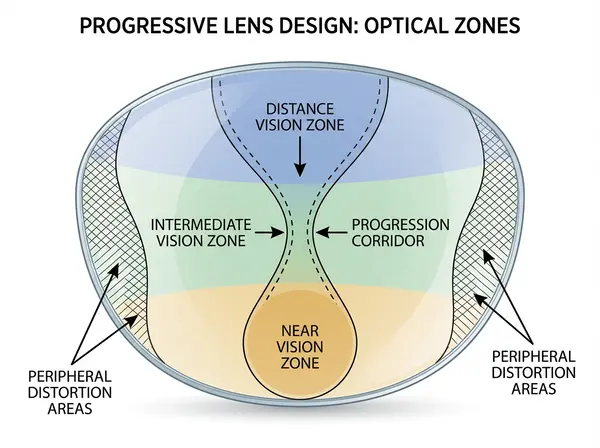
Beyond materials and coatings, lens design determines how you see through different parts of the lens.
Single-Vision Lenses
What they are:One prescription power throughout the entire lens—for distance OR reading, but not both.
Best for:
Under 40 (before presbyopia sets in)
Dedicated reading glasses
Dedicated distance glasses
Computer-only glasses (intermediate distance)
Cost:$50-$400 depending on material and coatings
Bifocal Lenses
What they are:Two distinct prescriptions in one lens—distance on top, reading on bottom, separated by a visible line.
Advantages:
Clear distinction between zones (easy to find reading area)
Less expensive than progressives ($150-$350)
Faster adaptation (2-4 days vs. 1-2 weeks for progressives)
Disadvantages:
Visible line (cosmetically dated)
No intermediate zone (computer distance requires separate glasses or head repositioning)
Image "jump" when eyes cross the line
Best for:People over 40 who need distance and reading correction, prefer simplicity, don't mind the line, have limited intermediate vision demands.
Reality:Progressives have largely replaced bifocals for most people, but bifocals remain viable for specific users.
Progressive Lenses (No-Line Multifocals)
What they are:Gradual transition from distance (top) through intermediate (middle) to near (bottom) with no visible lines.
Advantages:
Natural appearance (no lines)
Full range of vision (distance, computer, reading in one pair)
Modern solution for presbyopia
Disadvantages:
More expensive ($300-$800+ depending on design quality)
Require adaptation period (7-14 days)
Peripheral distortion in lower zones (blurry "swim" areas at edges)
Require proper frame selection and fitting
Quality tiers:
Standard progressives:Narrower corridors, more peripheral distortion ($300-$450)
Premium progressives:Wider zones, less distortion ($450-$600)
Digital freeform progressives:Fully customized to your measurements and frame, widest clear zones, minimal distortion ($600-$900+)
Our recommendation:Digital freeform progressives are worth the investment for first-time progressive wearers—easier adaptation and better long-term satisfaction.
Best for:Anyone over 40 needing multiple distances corrected, active lifestyles, people who don't want to carry multiple pairs.
Computer/Office Lenses (Occupational Progressives)
What they are:Specialized progressive lenses optimized for intermediate (computer) and near (desk work) distances, with limited or no distance correction.
Advantages:
Wider intermediate zone than standard progressives (less neck strain)
More natural head position for computer work
Ideal for desk workers spending 6+ hours daily on screens
Disadvantages:
Cannot be used for driving or distance activities
Requires separate distance glasses
Same cost as standard progressives ($300-$600)
Best for:Office workers, programmers, designers—anyone with heavy computer use who experiences neck pain or eye strain with regular progressives.
San Francisco context:Extremely popular among our tech workforce.
Special Lens Features: Photochromic, Polarized, and Tints
Photochromic (Transition) Lenses
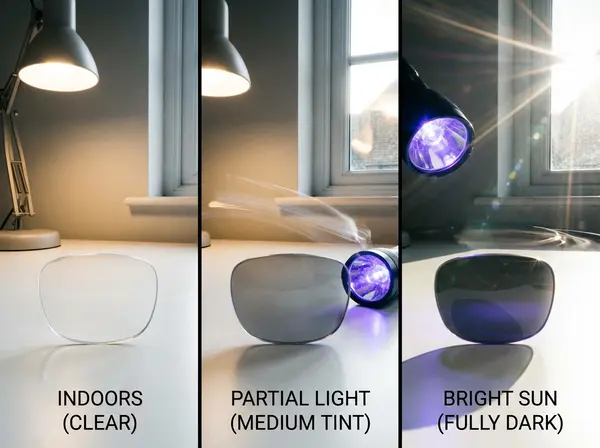
What they are:Lenses that darken automatically in UV light, returning to clear indoors.
How they work:UV radiation triggers molecules in the lens to change structure, darkening the lens. Indoors (no UV), they revert to clear.
Advantages:
Convenience (one pair functions as glasses and sunglasses)
100% UV protection always
Reduce squinting and eye fatigue outdoors
Disadvantages:
Don't darken inside cars (windshields block UV that triggers darkening)
Slower transition in cold weather (molecules respond slower)
Never get as dark as dedicated sunglasses
Add $100-$200 to lens cost
Best for:People who forget sunglasses, spend time transitioning between indoors/outdoors frequently, want simplicity.
Not ideal for:Drivers (won't darken in car), people needing very dark sun protection, those wanting fashion sunglasses separate from everyday glasses.
Brand options:Transitions (most popular), PhotoFusion (Zeiss), Sensity (Hoya)—all function similarly.
Polarized Lenses
What they are:Lenses with a filter that blocks horizontal glare from water, pavement, car hoods, and other reflective surfaces.
Advantages:
Eliminates glare (essential for water activities—sailing, fishing, beach)
Reduces eye fatigue significantly
Improves contrast and color saturation
Essential for driving in bright conditions
Disadvantages:
Makes LCD screens difficult to see (digital dashboards, ATMs, some phones)
More expensive ($100-$200 additional)
Only available in sunglasses or very dark tints (not practical for everyday clear lenses)
Best for:Prescription sunglasses for anyone spending time near water, driving frequently, or in bright environments.
San Francisco relevance:Critical for Bay activities—sailing, kayaking, waterfront running/cycling.
Tinted Lenses
What they are:Lenses with color added for sun protection, fashion, or specific visual tasks.
Common tints:
Gray:Neutral color perception, reduces brightness evenly (best all-purpose sunglasses)
Brown/Amber:Enhances contrast, good for variable light (driving in fog, overcast days)
Green:Reduces glare, maintains color balance (golf, tennis)
Yellow/Orange:Maximum contrast in low light (not for bright sun—too much light transmission)
Cost:$40-$100 depending on density and gradient
Best for:Prescription sunglasses tailored to specific activities.
Making the Decision: Matching Lenses to Your San Francisco Lifestyle
The Tech Worker (Prolonged Screen Time)
Prescription:Progressive with blue light filtering
Material:High-index (if strong prescription) or polycarbonate
Coatings:Premium AR, blue light filter, scratch-resistant
Special considerations:May benefit from dedicated computer glasses
Investment:$500-$800
The Active Outdoor Enthusiast
Prescription:Single-vision or progressive in impact-resistant material
Material:Polycarbonate or Trivex
Coatings:Premium AR, scratch-resistant, UV protection
Sunglasses:Polarized prescription sunglasses essential
Investment:$400-$600 for everyday glasses; $400-$700 for prescription sunglasses
The Commuter (BART/Muni/Driving)
Prescription:Progressive (if over 40) or single-vision
Material:Polycarbonate or high-index
Coatings:Premium AR (critical for night driving glare), anti-fog helpful
Special considerations:Photochromic lenses helpful for variable SF weather
Investment:$450-$700
The Budget-Conscious Buyer
Prescription:Single-vision or basic bifocals
Material:CR-39 or polycarbonate
Coatings:Basic AR, scratch-resistant, UV protection
Strategy:Prioritize essential coatings; skip premium upgrades
Investment:$200-$400
The Fashion-Forward Professional
Prescription:Digital freeform progressives
Material:High-index (thinnest for designer frames)
Coatings:Super-premium AR (best appearance and performance)
Frames:Designer frames benefit from premium lens investment
Investment:$700-$1,200+
Questions to Ask During Your Lens Consultation
When discussing lens options with your optician at Eyes in Disguise, these questions ensure you get exactly what you need:
"What lens material do you recommend for my prescription strength?"
"Will high-index lenses make a noticeable difference in thickness for my prescription, or is standard plastic adequate?"
"What's included in your premium AR coating versus basic AR?"
"Do you recommend blue light filtering for my screen time habits?"
"What's the real-world difference between standard and digital freeform progressives?"
"Can I see samples of different materials and coatings to compare?"
"What's your warranty/guarantee on lenses and coatings?"
"How long will these lenses realistically last with proper care?"
"What would you choose for yourself in my situation?"
"Can I upgrade coatings if I decide I need them later, or is it now-or-never?"
The Bottom Line: Invest Where It Matters
Modern eyeglass lenses offer remarkable technology, but not every option benefits every person. The key is understanding which features solve real problems in your life versus which are nice-to-have luxuries.
Essential for everyone:
Proper lens material for your prescription strength
100% UV protection
Scratch-resistant coating
Anti-reflective coating (at least basic; premium preferred)
Essential for specific needs:
Impact resistance (polycarbonate/Trivex) for active lifestyles
Blue light filtering for heavy screen users
Polarization for water activities and driving
Anti-fog for SF microclimates and mask wearers
Digital freeform progressives for first-time multifocal wearers
Nice-to-have (evaluate based on budget):
Photochromic lenses (convenient but not essential)
Super-premium AR coatings (marginal improvement over premium)
High-index for mild prescriptions (minimal thickness benefit)
At Eyes in Disguise, we guide you through these choices based on your prescription, lifestyle, budget, and priorities—ensuring you invest in lenses that genuinely improve your vision and daily comfort.
Ready to explore lens options for your next pair of glasses?
Schedule a comprehensive eye exam and lens consultation with Dr. Michelle Blas at Eyes in Disguise. Call (415) 474-5321 or visit eyesindisguise.com to book your appointment and discover the perfect lenses for your San Francisco lifestyle.
About the Author
Dr. Michelle Blas, OD, has dedicated her 30-year optometry career to providing exceptional vision care at Eyes in Disguise in San Francisco's Cow Hollow neighborhood. Board-certified with extensive training in pediatric optometry and myopia control, Dr. Blas serves families throughout San Francisco including Pacific Heights, the Marina District, Russian Hill, and the Presidio. She combines evidence-based medical care with personalized service, helping clients navigate eye health challenges with confidence and clarity.
FAQ SECTION(8 Questions)
1. Is high-index really worth the extra cost for my prescription?
It depends on your prescription strength. For prescriptions stronger than -4.00 (or +4.00), high-index provides meaningful thickness and weight reduction—worth the investment if aesthetics or comfort matter to you. For prescriptions between -2.00 and -4.00, the difference is marginal; standard polycarbonate may suffice. For prescriptions under -2.00, high-index offers negligible benefit—you're paying extra for no practical improvement. We'll measure lens thickness for your specific prescription in different materials so you can make an informed decision.
2. Do I really need anti-reflective coating, or is it just upselling?
AR coating is genuinely beneficial, not a gimmick—especially for night driving (eliminates headlight glare), computer work (reduces screen reflection strain), and high-index lenses (which are extremely reflective without coating). That said,qualityvaries significantly. Basic AR wears off faster and may have a slight purple-green tint. Premium multi-layer AR with hydrophobic coating lasts longer, cleans easier, and looks better. If budget is tight, basic AR is still worth it; if you can afford premium, it's a noticeable upgrade.
3. What's the difference between standard progressives and digital freeform progressives?
Standard progressives use a generic design optimized for "average" measurements. Digital freeform progressives are custom-calculated for your exact measurements (pupil distance, fitting height, frame tilt, vertex distance, dominant eye) and frame shape. The result: wider zones of clear vision, less peripheral distortion, and faster/easier adaptation—especially for first-time progressive wearers. The cost difference ($200-$400 more) is significant, but first-time progressive success rates are much higher with digital freeform designs.
4. Can I add blue light filtering later if I decide I need it?
No—blue light filtering must be added during lens manufacturing (either as a coating or embedded pigment). You cannot retroactively add it to existing lenses. This is why we discuss your screen time habits during your exam—if you're uncertain, we can start with blue light filtering since you can't add it later. Alternatively, blue light blocking computer glasses (non-prescription or low-power readers) can supplement regular glasses.
5. Why are polycarbonate lenses recommended for kids but you're suggesting Trivex for me?
Polycarbonate's impact resistance makes it essential safety eyewear for children (who are more likely to break glasses during play/sports). For adults, especially those in less active roles, Trivex offers the same impact resistance plus superior optical clarity—a worthwhile upgrade. However, if you cycle, play sports, or have an active lifestyle, polycarbonate remains an excellent choice and costs less. The decision depends on your priorities: maximum clarity (Trivex) or budget-friendly impact resistance (polycarbonate).
6. How do I know if I need dedicated computer glasses or if progressives will work?
If you spend 6+ hours daily on computers and notice neck strain from tilting your head to find the intermediate zone in progressives, dedicated computer glasses often provide relief. However, try standard or premium progressives first—many people adapt well. If neck pain persists after 2-3 weeks, we can prescribe computer glasses optimized for your desk setup. Most people don't need both, but heavy computer users (programmers, designers, data analysts) often benefit significantly from dedicated computer lenses.
7. Should I get photochromic lenses or separate prescription sunglasses?
This depends on convenience versus performance preferences. Photochromic lenses offer convenience (one pair does both), but they don't darken in cars (windshields block UV) and don't get as dark as dedicated sunglasses. If you spend significant time driving or near water (where glare reduction is critical), dedicated prescription sunglasses with polarization are superior. Many people choose both: photochromics for everyday convenience, plus prescription sunglasses for driving and outdoor activities.
8. How long will my lenses last before needing replacement?
Lens lifespan depends on prescription stability, coating quality, and care habits. Coatings typically last 2-4 years with good care (premium coatings last longer). However, most adults need prescription updates every 1-3 years, triggering lens replacement regardless of coating condition. If your prescription is stable and you care for lenses properly (daily cleaning, case storage, avoid scratching), lenses can last 3-5 years. Signs you need new lenses: visible scratches affecting vision, coating deterioration (peeling, hazing), or prescription changes.
